
The Questions We Ask And The Questions We Answer: Procedural Generation in RPGs
Noa Chazan explores the history and nature of procedural generation in role-playing games: from random tables to card prompts and computer calculations.
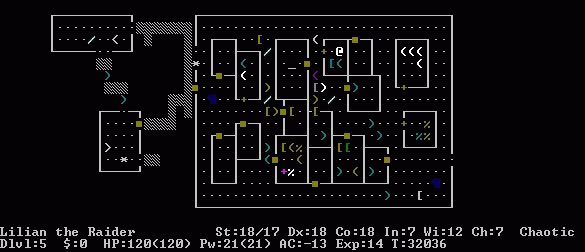
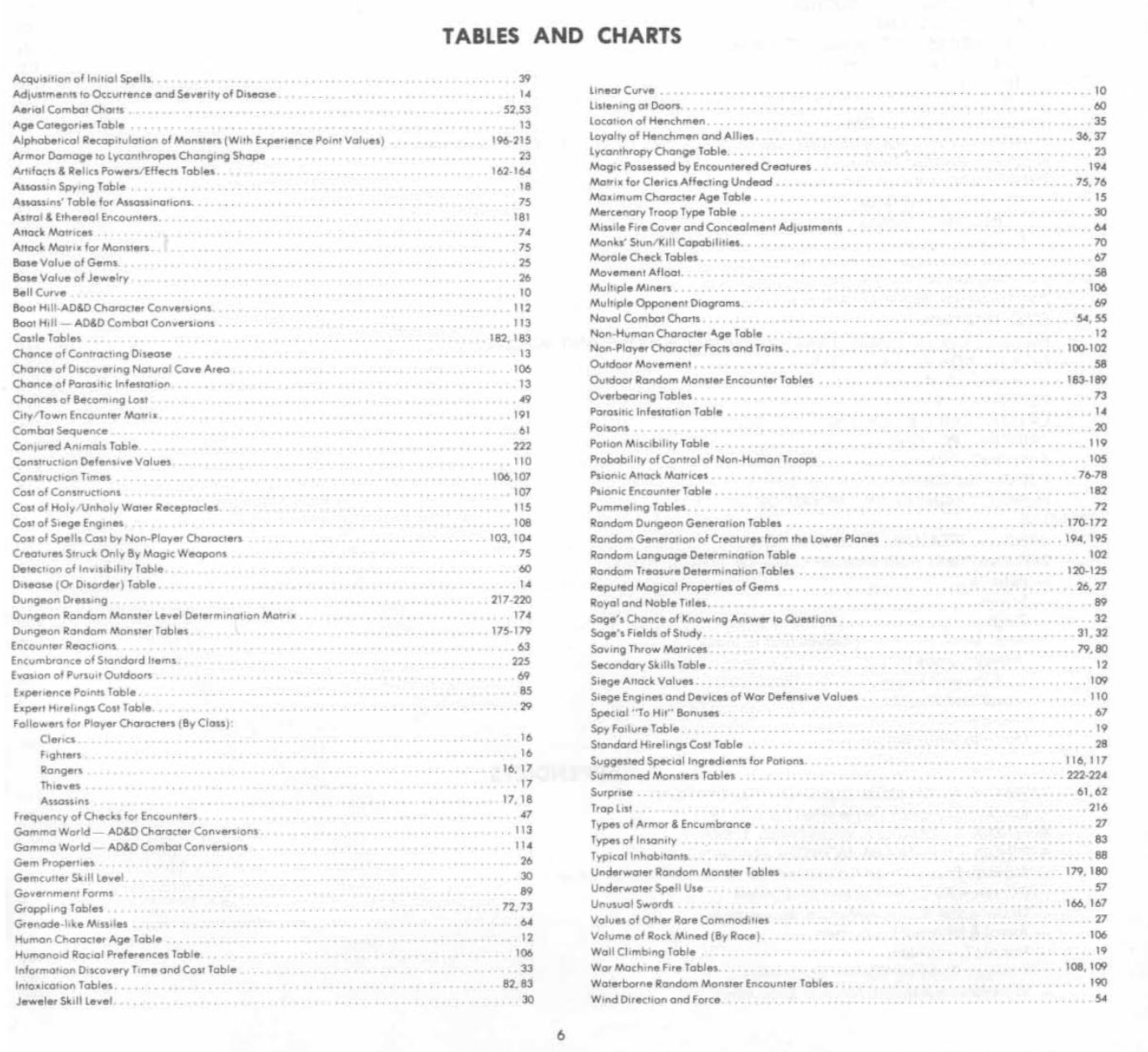
The random tables that have been a feature of tabletop role-playing games (TTRPGs) since the 1970s are one of the first forms of procedural content generation. Advanced Dungeons & Dragons (1977)’s Dungeon Master’s Guide has 122 random tables – more than one every two pages – including tables for Chance of Parasitic Infestation,Potion Miscibility, and Volume of Rock Mined (By Race) 3. Many of the first computer RPGs (CRPGs) were attempts to replicate the experience of playing a TTRPG digitally, such as dnd (1975 – presumably based off of the original 1974 D&D ruleset)4, Dungeon(1975)5, and Template of Apshai (aka Dunjonquest, 1979 – it advertised itself explicitly as a “version of Dungeons & Dragons”)6.
These inspired more commercial computer role-playing games (CRPGs) – Ultima (1981) borrowed the list of character statistics nearly exactly from D&D7, while Pool of Radiance (1988) and its followups were explicitly licensed by TSR, the publisher of Dungeons & Dragons, as adaptations8. Another parallel strand of CRPGs, known as Roguelikes, used procedural generation even more extensively for generating random dungeons. NetHack (1987), the early Roguelike with the most staying power, borrowed lists of monsters and items from D&D9. In the decades since, the various styles of CRPGs and TTRPGs have developed their own procedural generation techniques used for their own purposes. What is predecided, and what is randomly determined? What is the same between every playthrough, and what varies?
Procedural generation in digital and procedural generation in tabletop games have each evolved towards the strengths of their medium. Computer RPGs lean into quantity – the procedure of procedural generation can be extremely complex when performed by a computer that can do millions of calculations per second. This makes it possible to generate things like entire worlds or photorealistic flora and fauna. In fact, one of the most common use cases of procedural generation in digital game development at this point doesn’t even occur during gameplay itself. Tools such as SpeedTree are used to procedurally generate foliage and landscapes during the development process in order to create realistic environments full of similar but distinct trees, plants, and rocks without an artist needing to model hundreds of individual plants themselves. The developers can later tweak the result to exactly match their artistic vision. Since its first use in Elder Scrolls: Oblivion (2006), SpeedTree has become an industry-standard tool.10
Since procedural generation in tabletop games is often done at the table using dice, it tends towards simpler procedures. TTRPG procedural generation leans into the benefits of having humans at the table: ambiguity, interpretation, and personal experience. While digital procedural generation must produce a complete artifact that makes sense in context, tabletop procedural generation is more flexible. While many TTRPG generators do generate concrete answers, a generator for a TTRPG only needs to generate an interesting question – the players will take it from there.
In fact, in many recent TTRPGs, the random tables have evolved into “picklists,” where the player can choose themselves from among a series of options designed to stimulate their creativity. Often these options are designed with blank spaces for the player to fill in – they’re prompts, rather than conclusions. On the other hand, many well-known storygames such as Avery Alder’s The Quiet Year build their gameplay around a core random table to generate storytelling prompts. In The Quiet Year, the main gameplay loop is drawing a card from a deck of playing cards, which is cross-referenced on a table called the Oracle to produce a question that the active player answers to progress the story.11
As there are 52 cards, so there are 52 weeks. We won’t necessarily get to play them all - the Frost Shepherds could arrive any time during Winter. Most cards have two options to choose from, with an “or…” divider in between. Pick the option that you find the most interesting and fitting, and read the text aloud. The card might ask you a question, bring bad news, or create an opportunity. 12
Here’s an example in practice from the actual play podcast Friends at the Table:
Austin Walker: And now we’re back around to me. Queen of Spring. Huh. “What’s the most beautiful thing in this area?” or “What’s the most hideous thing in this area?” So I can tell you what’s hideous. They come up out of the grey that was underneath the obsidian— er, not the obsidian, the black beaches. The rich people are probably not super fond of this, but these strange lizard dogs show up.13
Notice the main evolution here – procedural generation has gone from a way of randomly determining an answer to randomly determining a question.
While these approaches bring different strengths, they also each have their own pitfalls. The simplistic procedural generation techniques used in TTRPGs can be transparent enough to players that the framework can start to show through. After playing The Quiet Year a few times, you begin to see the same questions come up over and over, and see how the design of the game nudges your story in particular directions. For example, in Friends at the Table, when the question “Are there children in the community? If there are, what is their role in the community?” comes up, the answer is that there’s a compound where the children are kept communally14 – a community structure that also appeared in my own game when I played The Quiet Year. Players’ tendency to avoid the most obvious answer leads to noticeable trends in the stories produced during gameplay.
These simpler tools work well in TTRPGs because there is plenty of room for error in the generation results. Any information that might seem out of place or repetitive can be folded into the story by player creativity. Often the results that seem the least “right” on the surface become the most interesting and memorable moments in a game. This is a significant help when building generators that digital procedural generation doesn’t have access to.
Digital procedural generation lacks the failsafe of player creativity to fill in the gaps, so it often needs to narrow the range of possibilities that can be generated to minimize the risk of generating something “wrong.” This can lead to what Kate Compton named the “10,000 bowls of oatmeal problem,” 15 where a generator generates a huge number of artifacts that are visibly nonidentical but nevertheless have the same “texture.” Every bowl of oatmeal has a different arrangement of oats, but these differences are unimportant to the consumer. This is a problem if the goal of the procedural generation is to add interest, but not as important if the goal is more narrow – having every tree in a digital forest be unique improves the appearance of the forest even if each individual tree is not particularly interesting. This leads to the generator building in tight guardrails. For example, many roguelikes have implemented their dungeons so that certain elements are kept consistent while randomizing the layout, rather than having the dungeon generator be fully open-ended.
Procedural generation is also used in the creation of digital art. While computer art has taken advantage of procedural generation techniques since the 1960s (for example, the works in the 1968 Cybernetic Serendipity exhibit16), in the late 2000s and early 2010s there was a surge in procedural generation for the purpose of creating artistically-oriented bots, often on Twitter. These are very instructive because they combine elements of TTRPG and CRPG procedural generation techniques. Since they’re implemented using a computer, they typically have more complexity in the generation procedure than is common in TTRPGs – but since their purpose is to function as art, their goal is to evoke feelings and ideas in an audience rather than to make a perfectly coherent game artefact.

Often the most successful bot tweets are tweets that have some connection to the real world or people’s lived experiences, which the random generator happened to coincidentally arrive on. For example, the “fuck every word” bot, which posted every word in the dictionary prefixed by the word “fuck,” got fewer than ten likes on the majority of its tweets17. However, “fuck nazis” has 16k likes18. When it comes to open ended procedural content generation, each viewer is a complete person bringing their own reference frame. In the TTRPG context, this means that each group has its own particular table culture that brings answers to the open ended questions raised by the game. The best generators can draw this out to produce artifacts that resonate strongly with the people at the table.
The superpower of the TTRPG is that the players at any table are powerful engines of creativity. They can handle “risky” generators where not every result is perfect. They can handle generators and resolution mechanisms that are extremely abstract. In fact, “nonsensical results” or extremely abstract mechanics can encourage player creativity. And creativity is not the only thing players bring to the table – they bring their surroundings, histories, and knowledge. TTRPGs are not just a medium for creating stories, they are a way to draw out players’ selves to be shared with the whole table. The story that was generated is not the actual point. While many generators generate answers, TTRPG generators generate possibilities.
Author
Noa Chazan is a designer of board games, tabletop RPGs, and also other stuff. She is interested in when games blur boundaries - between the real world and the game world, between language and meaning, or between genres of play. She is the creator of the Playing With Words flash fiction writing card game Situations and the upcoming craft-based wizard tabletop roleplaying game Chromatic Conjuring. More of her writing about games and progress updates on her projects can be found at noa.land.
Bibliography
Alder, Avery. The Quiet Year. 2013; Buried Without Ceremony, 2019.
Automated Simulations. “Is It Dungeons and Dragons or Dragons and Dungeons?” Creative Computing (Morristown, NJ), January 1980. Https://archive.org/details/CreativeComputingbetterScan198001/mode/2up, p. 179. Internet Archive.
Compton, Kate. “So You Want to Build a Generator...” Blog. Kate Compton, February 22, 2016. https://www.tumblr.com/galaxykate0/139774965871/so-you-want-to-build-a-generator.
Daglow, Don L. “The Changing Role of Computer Game Designers.” Computer Gaming World (Cambridge, MA), August 1988. Https://www.cgwmuseum.org/galleries/issues/cgw_50.pdf, p. 18. Computer Gaming World Museum.
Davenport, James. “From The Elder Scrolls to the US Secret Service: Where Videogame Trees Come From.” PC Gamer, September 6, 2017. https://www.pcgamer.com/from-the-elder-scrolls-to-the-us-secret-service-where-videogame-trees-come-from/#comment-jump.
“Fucking Every Word.” Twitter account. Accessed September 15, 2026. https://x.com/fuckeveryword.
Gygax, Gary. Advanced Dungeons & Dragons, Dungeon Masters Guide: Special Reference Work: A Compiled Volume of Information Primarily Used by Advanced Dungeons & Dragons Game Referees, Including Combat Tables, Monster Lists and Encounters, Treasure and Magic Tables and Descriptions, Random Dungeon Generation, Random Wilderness Terrain Generation, Suggestions on Gamemastering, and More. Rev. ed. TSR ; Distributed in the United States by Random House, 1979.
IGN. “Top 100 RPGs of All Time.” 2012. Https://web.archive.org/web/20120915010613/http://www.ign.com/top/rpgs/46. WayBack Machine. http://www.ign.com/top/rpgs/46.
Maliszewski, James. “Retrospective: Temple of Apshai.” Grognardia, August 14, 2024. https://grognardia.blogspot.com/2024/08/retrospective-temple-of-apshai.html.
Maliszewski, James. “Retrospective: Ultima.” Grognardia, September 25, 2024. https://grognardia.blogspot.com/2024/09/retrospective-ultima.html.
Martell, Carey. “Interview with the Creators of Dnd (PLATO).” RPG Fanatic, April 26, 2012. http://www.rpgfanatic.net/advanced_game_wiki_database.html?p=news&nrid=5049&game=dnd.
Nethack Wiki. “Dungeons & Dragons.” May 4, 2026. https://nethackwiki.com/wiki/Dungeons_%26_Dragons.
Walker, Austin, Keith J. Carberry, Janine Hawkins, Nick Scratch, and Art Tebbel, hosts. The City of Light Pt. 1. Episode 1. Friends at the Table: Marielda. July 14, 2016. 2:06:13. https://friendsatthetable.net/marielda-01-the-city-of-light-pt-1.
Footnotes
1 Gygax, Advanced Dungeons & Dragons, Dungeon Masters Guide, 6.
2 Automated Simulations, “Is It Dungeons and Dragons or Dragons and Dungeons?”
3 Gygax, Advanced Dungeons & Dragons, Dungeon Masters Guide, 6, 13, 106, 119.
4 Martell, “Interview with the Creators of Dnd (PLATO).”
5 Daglow, “The Changing Role of Computer Game Designers.”
6 Maliszewski, “Retrospective: Temple of Apshai.”
7 Maliszewski, “Retrospective: Ultima.”
8 IGN, “Top 100 RPGs of All Time,” 46.
9 Nethack Wiki, “Dungeons & Dragons.”
10 Davenport, “From The Elder Scrolls to the US Secret Service: Where Videogame Trees Come From.”
11 Alder, The Quiet Year.
12 Alder, The Quiet Year, 5.
13 Walker et al., The City of Light Pt. 1, at 0:49:33.
14 Walker et al., The City of Light Pt. 1, at 0:53:41.
15 Compton, “So You Want to Build a Generator...”
16 Pattison, “Cybernetic Serendipity Archive.”
17 “Fucking Every Word.”
18 fucking every word, “fuck nazis.”