
Scenes and their Progeny
Evan Torner explores the history of magazines in the role-playing game scene
In a piece from Issue One, Evan Torner explores the history of magazines in the role-playing game scene, contextualising the first issue of Playtest Material within a genealogy of criticism.
On the morning of January 6, 2021, without yet knowing what horrors that day would produce, I reached out to the editor of Knucklebone Magazine, John R. Harness, with an article pitch for their forthcoming third issue. John accepted it, and the article below was featured as an "Early Access" essay on Patreon for the issue. However, Knucklebone Issue 3 "FORM" was never to appear. However, what I wanted to say back then, I still want to say to you now, dear reader, and so you find it here in the pages of Playtest Material.
–Evan Torner, Cincinnati, USA, July 2026
Role-playing game periodicals come and go, but patterns of theory production remain constant. Young creators see the design work of the older generation and, although they admire it, seek to critique it too. They build and test theories to form a new aesthetic in alignment with their tastes and, when the time is right, they publish their own RPG creations as part of an intergenerational artistic dialogue. Like-minded creators publish and form a "scene." It functions for a while until it dissolves under various pressures. Several of the young theorists will go on to achieve fame and creative prominence, and perhaps more than a few others in the scene will look past any late-stage ambivalence or dysfunction, and at the materials created, with fondness.
Knucklebone magazine reflects an ongoing international RPG dialogue. Others pre-date it, of which I'll name just a few: Alarums & Excursions, Different Worlds, Inter*Action, Imagonem, panclou, Push, and Playground, among many. Such RPG zines survived, if at all, off the energy of the fans, since the zines themselves hardly ever recouped revenue for the funds invested in their creation. Yet they were also sites of core discussions in RPGs. Known and cherished creators got their start in publishing for a wider readership within the zine scene. Major debates in RPGs took place in their pages, as creators challenged themselves to lay out their ideas in public longform for the community and, ultimately, the archive.
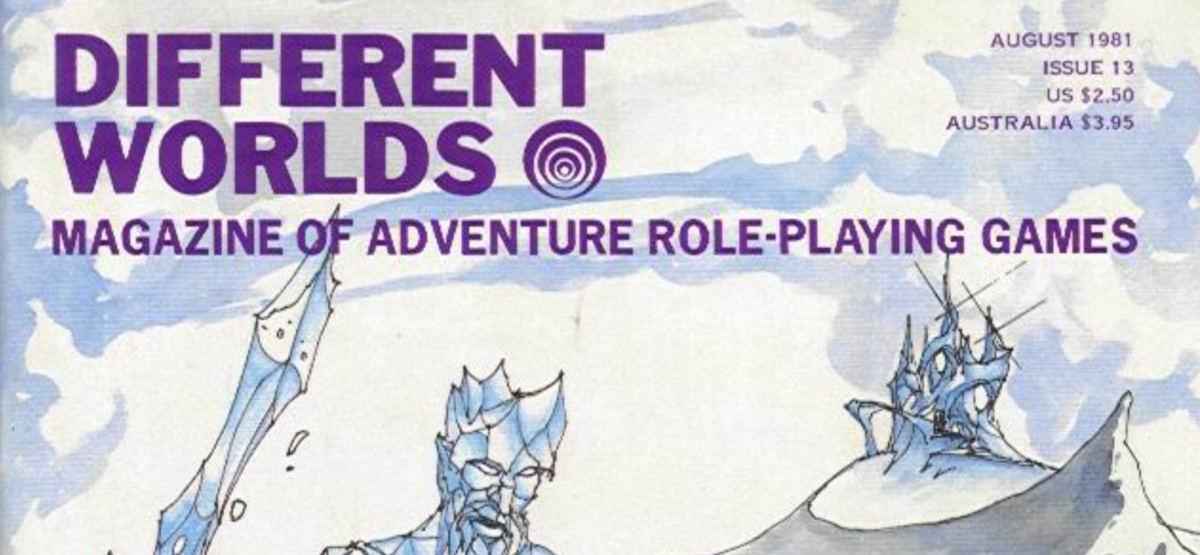
Here, I am going to focus on just one of the zines I mentioned above: Different Worlds (1979-1987). Created and edited by Tadashi Ehara for Greg Stafford's RPG company Chaosium, prior to the release of their blockbuster hit Call of Cthulhu, Different Worlds was, in principle, a zine occupying similar space as Dragon magazine or White Dwarf: a "house organ" of an established publisher. But Ehara saw what Alarums & Excursions was doing to advance the discourse, so Different Worlds would follow their model throughout the 1980s: a zine dedicated to all role-playing games, no matter the publisher. Different Worlds was a place where you could find RPG scenarios for all manner of game systems, product reviews, theoretical musings, and in-game fiction. But it was also a foundation stone of the global indie RPG scene. Thanks to Different Worlds, designers such as Greg Costikyan and Ken Rolston of Paranoia (1984) fame would share space with the likes of Lee Gold (Alarums & Excursions editor), Dave Arneson (Dungeons & Dragons), Ken St. Andre (Tunnels & Trolls) and Lewis Pulsipher (Britannia). Jonathan Tweet is featured in the final issue, #47 (Fall 1987), with some rules for Egyptian magic in Call of Cthulhu, as the magazine gave voice to the second generation of notable RPG designers. Different Worlds serves as an artifact of an earlier scene with a vision to unite different RPG creators under one roof. It reminds us that scenes over decades never separated RPG theorising from commerce, gossip from discussions of serious issues, game reviews from play materials, and the "industry" from its self-published indie roots. I'd like to use Different Worlds as a mirror of sorts to reflect RPG discourse over decades.
"It was never a moneymaker by itself," Ehara said of Different Worlds. "But it was worth it." Different Worlds proved a contact zone between various corners of the ever-more robust RPG hobby as it underwent what Jon Peterson describes (in an excellent monograph of the same title) as "the elusive shift" of 1979-1980: when the science-fiction/fantasy fandom merged with the wargame fandom, and when RPGs went mainstream enough to solidify what a "role-playing game" was, prompting an explosion of competing titles, systems and franchises. Ehara's zine, alongside Alarums & Excursions, captured the energy of this exciting moment. It was deliberately designed to do so. Let's take a look at Issue #4 (August/September 1979), for example. It opens with Ehara's editorial admonishment of the industry: "The RPG state of the art is dull. You can count on the fingers of your hands the number of innovative systems." he writes, "...The Role-Playing Game is far from complete." He renews the founding commitment of Different Worlds to "further the hobby, its craft and artistry." Next is an article "Games to Gold" by Rudy Kraft, co-designer of RuneQuest with Steve Perrin and Greg Stafford. The piece reports the results of a survey sent to all "major simulation gameing [sic] companies" that might accept freelance, independent submissions. This extremely practical guide, containing both company addresses as well as detailed instructions on how to submit a game for publication and their general interest in third-party work, echoes across the decades, as any new designer asks themselves "How can I get my work out there?" It even comes with an anonymous letter recommending any creator to "get a good lawyer." Sections that follow include advice for first-time game masters, an actual-play report from a Star Trek module run at DunDraCon IV, and a system-agnostic table for generating enchanted weapons in fantasy gaming. Steve Lortz, whose Chaosium fantasy RPG would become the basis for Sandy Petersen's Call of Cthulhu, follows this material with "A Perspective on Role-Play," a synoptic historical view of how TTRPGs came to be and even an intellectual engagement with role-play in sociology and psychology. Here, we have a serious attempt — with academic receipts — to situate "adult recreational role-play" within a wider intellectual history. Stafford's preview of then-forthcoming game HeroQuest is the next piece, followed by acrimonious letters-to-the-editor regarding Issue #2, wherein Costikyan excoriates Lortz for a positive review of David Feldt's RPG Legacy ("I find it difficult to believe that Mr. Lortz and I purchased the same game."). Finally, the regular gossip column by Gigi D'Arn "A Letter from Gigi" regales the reader with snippets of gossip compiled from Chaosium staff and other industry figures. I myself couldn't help but laugh at a report of a fight between 2 distributors over a spacecraft miniature: "Is ORIGINS a convention or a brawl? Glad to hear it's the latter – much more fun that way."
Going into depth on a single issue of Different Worlds yields a number of insights on TRPG development scenes and their progeny. The first is that art, law, commerce, academics, theory, publishing, actual play, complaining about conventions, and outright slander have intermingled in the tabletop RPG scenes since long before their inception. One should roll one's eyes equally at insinuations that a scene is becoming too commercial, too academic, too focused on publishing, or too experimental. Different Worlds as a general mixing space for TRPG discourse models the kinds of folks one would find in the scene for decades. Another insight is that there is, in fact, little separating what one would call "indie" parts of the scene and their more professionalised cousins. Even a multi-billion-dollar operation such as Hasbro / Wizards of the Coast – as Chaosium and others back in the day – relies on the talents and artistic engagements of successive waves of game designers to make relevant and interesting content for their audience. The pages of Different Worlds reveal that those engaged in public critiques of TTRPG products and people are more likely than not on a course to become The Establishment of the hobby, at least for a time. Fanzine discourse moves from the margins to the centre, not the other way around. Costikyan and others would later appear in the Hogshead Publishing attempt at a mixed TTRPG discourse periodical, Inter*Action, now increasingly credited with establishing the foundations of modern game (design) studies and TRPG theorizing from the late 1990s and beyond. In essence, here, in these pages, we take part in a rolling multi-generational conversation, one that'll have strange ramifications after we're gone. Ideate. Iterate. Write. Publish. Critique. Complain. It will all run together in the end, anyway.
Evan Torner is Associate Professor of German and Niehoff Professor of Film & Media Studies at the University of Cincinnati, where he directs the BFA in Games and Animation and the UC Game Lab. He cofounded and co-runs Analog Game Studies and the Golden Cobra Challenge.