
Sitting Down and Telling Stories: learning TTRPG skills from Rakugo
What do tabletop role-playing games have in common with Japanese sit-down comedy? In this article, D. "Zhen" C. explores the art of Rakugo and explains how TTRPG GMs and players can learn from its structured storytelling techniques.
What do tabletop role-playing games have in common with Japanese sit-down comedy? In this article, D. "Zhen" C. explores the art of Rakugo and explains how TTRPG GMs and players can learn from its structured storytelling techniques.
Rakugo: A brief introduction
落語/Rakugo (literally “Fallen words”) is a performance art from Japan, broadly inspired by the sermons of 17th century priest Anrakuan Sakuden, collected in his book the Seisuishō, (“Laughs to Wake You Up”).1
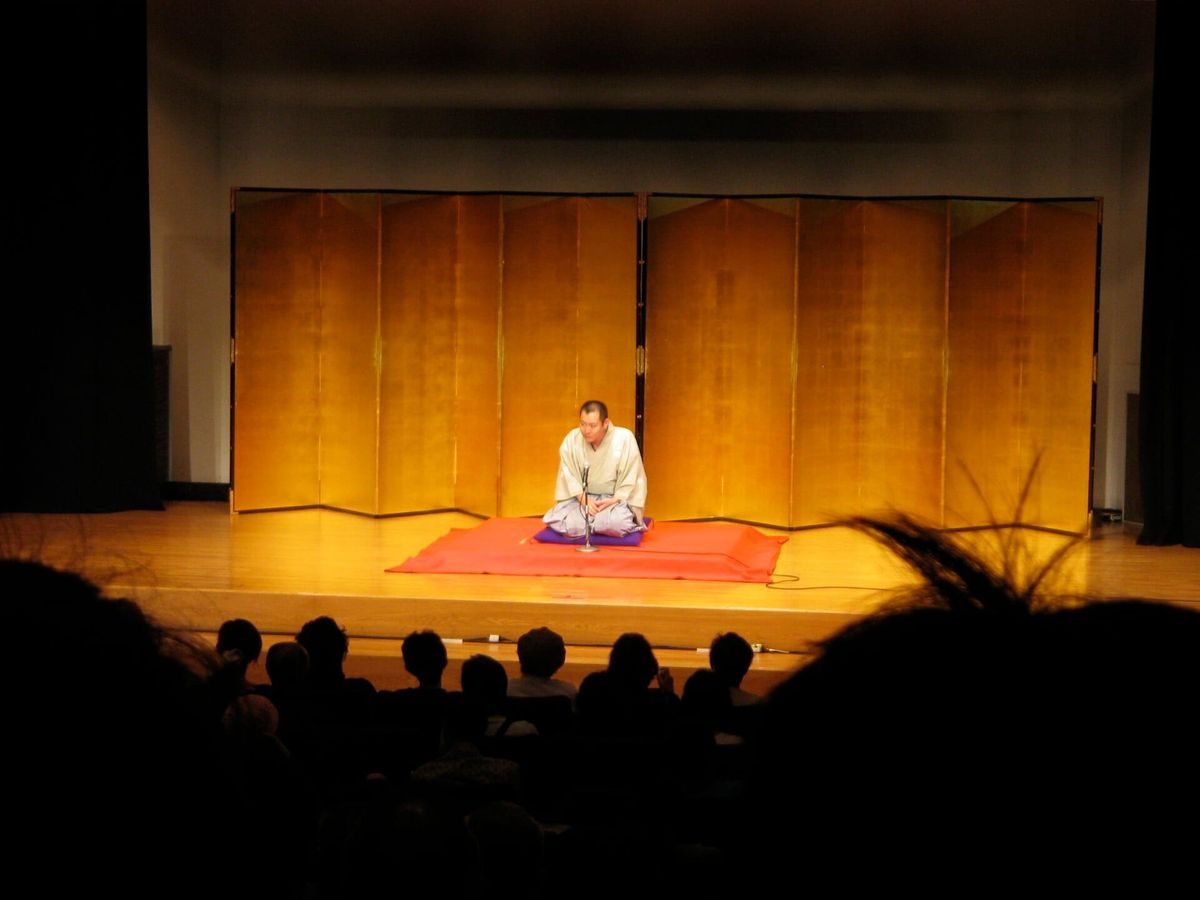
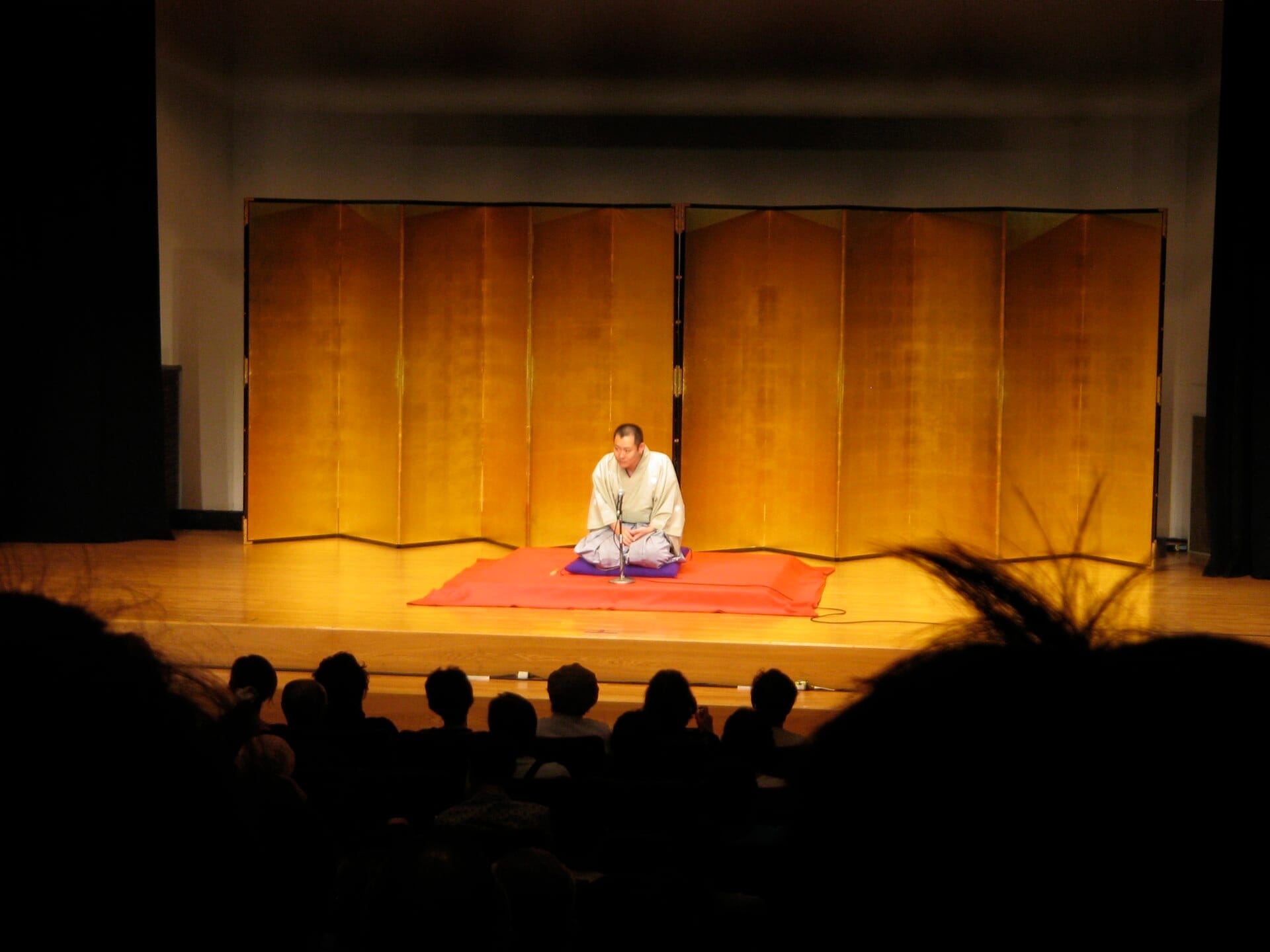
From Sakuden’s day up to the 20th century, two schools of Rakugo emerged: Edo Rakugo from Tokyo, known for being serious and literary, and Kamigata Rakugo from Osaka, described as having hade,meaning a distinct flavour of liveliness and flamboyance.2 Using a library of at least 300 classic stories known as the koten-banashi,3 Rakugo is usually performed in Yose theatres.4 An audience will be presented with a zabuton cushion in front of a microphone onstage, and sometimes a knee-high table in front of the zabuton.
Once the show starts, each performer in a lineup will take turns entering the stage serenaded by music. All Rakugoka(the title for performers of Rakugo) wear a kimono and carry on them a sensu(paper fan) andt engui(cloth towel) as props. The lone performer kneels on the zabuton, takes a bow and begins their performance.
Rakugoka start with the Makura, introducing themselves to the audience in a way which ties into the story they intend to deliver, and to provide essential context. The story proper, Hondai, follows on, which lasts between five minutes to an entire hour, each interspersed with key scenes that form the framework and define akoten-banashi. All stories end with an Ochi (literally “drop”), a pun or a punchline, which rounds out the story. The current performer leaves and the stage is prepared for the next one, who tells a different story. Performances continue until they all have taken a turn.
Rakugo, despite being a young tradition that is only three centuries old, is culturally important to the point where it is registered as an Intangible Cultural Property of Japan.5 Though there are many defined conventions, Rakugo as an art form in service to its audience has been constantly adapted, having survived even after World War II, when it was threatened with being banned for cultural irrelevancy.6
Rakugoka and GMs: Who takes responsibility for a story?
One commonality between Rakugo and TTRPGs is that performers do not need to have any background or pedigree to begin learning. Rakugo and TTRPGs can be learned through self-study, though there is a cultural expectation that mastery is attained through practical learning; be it observing and serving a Rakugo master7 or playing in multiple TTRPG game sessions.8 In both cases: anyone can take to the stage to tell a story or run a game so long as they have an audience, and produce a complete experience.
However, Rakugo is a solo act. Even when multiple Rakugoka are working as a collective to put on a show in a Yose theatre, each performance is individualised and independent by design. Only one performer is on stage at a time, the rest of the troupe support them. Individuality is heightened by Rakugo’s hierarchical systems based on the level of expertise. Beginners, or Zenza, are expected to serve the Secondary acts (Futatsume/Nakaza), and Secondary acts in turn are supposed to serve the Masters (Shin'uchi.)
Zenza training takes up to three years, during which they must support their master and seniors while learning Rakugo on the side. In the times they are not serving tea, cooking, folding clothes, or generally attending to a master, Zenza must watch and learn second-hand from other performers. On the occasions that a Zenza’s master is free, they teach banashi in the form of a lesson.
Such rules may be seen as strict, but the intention of this is to practice empathy, to the point where they can intuit what people want and like. Kamigata Rakugo describes this principle as providing Sābisu (Japanese loan word of “service”),9 and exemplifies it through their commitment to a fuller experience in their longer banashi and incidental music.10 The core principle of Sābisu can be summarised with the phrase: “If you cannot make one person happy, how can you make an entire audience happy?”
The idea of one person taking primary responsibility for storytelling, combined with viewing this act as an expert’s act of service, has not remained within Rakugo only. We see this present in Japanese RPG designs, even in how they are called “Tabletalk Roleplaying Games” (TRPG for short) instead of “Table top roleplaying games” (TTRPGs). TRPGS put performance at the front and centre in a regimented and structured way. Golden Sky Stories (Yuyake Koyake), for example, defines the role of Narrator as someone who must “Weave a happy story” for their players while letting them “do what [they] want”.11 The structure breaks down play into scenes, and players are both participants as well as an active audience. You can give other players tokens as rewards for good play, and in turn those rewards turn into points that allow your character to use their abilities.
Such processes are overseen by the Narrator, whose role is something of curator of the game’s events, much in the way the Rakugoka has fine control of their storytelling. Whilst leaving room for play, heightened GM responsibility is built into the fabric of the game. Rakugo performance techniques, with their focus on the individual lead storyteller, may be suited for more GM-centric styles. A GM will benefit most from applying the principles of Rakugo if they understand themselves as the one “leading” the performance.
The history of TTRPGs is rooted both culturally and design-wise in a mindset where through curated and isolated preparations, a GM will find artistic satisfaction in presenting a game for their players.
This is not an alien approach in TTRPG, though it may have fallen out of fashion in some circles. The history of TTRPGs is partly rooted, both culturally and design-wise, in a mindset where through curated and isolated preparations, a GM will find artistic satisfaction in presenting a game for their players. These days, TTRPG culture has partially shifted from this “traditionalist” approach and designs have explored beyond single GM storytellers. On the other hand: a more structured approach which holds a single individual as “head storyteller” is still an important, and very valid, sensibility within TTRPG culture.12
Hondai and Koten-Bananshi: The Art of Iteration
In Rakugo, the koten-banashi are the canonical stories that all Rakugoka must learn to master the form and style of storytelling. TTRPGs, on the other hand, often have pre-written example “modules” included in the game book or sold separately, which are the primary tool for learning games without a teacher.13 Modules and koten-banashi fulfill essentially the same role; they are vectors, used to deliver the information required to perform the “essential functions” of the storytelling medium.
Koten-banashi and adventure modules have independently been compared to jazz musical performances. Katsura Sunshine, the first Canadian Rakugoka, specifically likens the Koten-banashi to jazz standards that one practices prior to a show.14 Further to the analogy: the jazz performance, akin to a yose theatre show, features collective performers (who have likely never met each other before), who must coordinate an entire programme that will appeal to the audience. Yose theatre collectives are very reactionary yet practised, notably ensuring consecutive stories won’t share similar themes.
David Blandy’s article “How to write an OSR adventure” similarly comments on RPG module adventure structures, in particular for the Old School Renaissance style. He describes “a web of connections, in terms of relationships, space and time”. Much like a jazz standard, modules are the basis for performers to interpret and improvise for their games.15
To illustrate with an example that has many recorded performances in English, the Koten-banashi of Momotaro must have the following scenes:
- A father tells his son the fairytale of Momotaro to put him to bed.
- Son falls asleep, and the father comments “Children are so innocent!”.
- The son grows up and tries to tell the same fairytale to his child.
- Child asks annoying questions about the story to his father
- Son’s son, wide awake, criticises his father’s rendition of the story.
- Father (the first Son) dozes off.
- Ends with Ochi of Son’s Son remarking: “Parents are so innocent!”
Within those limits, a Rakugoka can tell a story however they see fit. Many Rakugoka characterise the son’s son as erudite, exclaiming how Momotaro’ story is a metaphor for trusting others, along with historical details on lunch of millet cake packed by Momotaro’s parents for his journey to Oni Island as a symbol of frugality over taste.16 Other versions of the son may teach of the story details that were changed to make them more relevant to an audience, such as how later versions made the couple that found the peach older, because “in the old days, grandparents were very close to the children”.17 Yet another performer may dissect the symbolism of the dog (loyalty), monkey (intelligence) and the pheasant (courage), as well as the Oni/trolls representing the mean people of the world, with the “treasures” as a reward being a symbol of trust.18
Occasionally, Rakugoka may go even further to rewrite content for audiences that may not understand Japanese cultural references: Tenshiki may be adapted from a story about a buddhist teacher to one of a University research lab,19 or “Scared of Manjuu” may become “Scared of Hamburgers” for a Western audience where sweet bean paste desserts are not well known.20
Blandy argues that good module writing should be about preparing events that players need to respond to. Preparation and adventure design focus should be on location descriptions, things to discover, codified “stat blocks” for encounters, and have a broad overview in the form of a “simple flowchart or a map”. Descriptions and information can be defined, but the “clear evocative prose” leaves space for the imagination of the players, and the GM to fill in.21
You can see such structures and patterns in many contemporary TTRPG modules, including Dungeons and Dragons anthology adventures. The Uncaged Anthology: Goddesses, notable for being one of the DM’s Guild platform’s highest “Adamantine” bestsellers and for winning two Ennie awards in 2022, follows a standardised format which was sent to each of the 21 authors.22
One can see how the format has been utilised in the opening adventure, “Winter’s Mourning”:23 an initial “Synopsis” to summarise the adventure, context sections to explain why the adventure is happening (“Adventure Background”) plus linking the PCs to go on the adventure (“Adventure Hook”), a three chapter structure, which is replicated through most of the rest of the texts; “Development” sections that link chapters and determines what events allow for progression, the “Conclusion” that determines outcomes based on player actions, and a section for “Rewards” in the form of magical items for completing the adventure.
Clearly, these two things are not exact equivalents. Rakugo stories tend to provide a “plot” based on specific themes, whereas many modules are written to be taken in a different order each time, even being adjustable through means such as random tables or tarot cards (see Curse of Strahd’s recent iterations.) What is notable, however, is that both are written in the understanding that they will be perpetually reinterpreted.
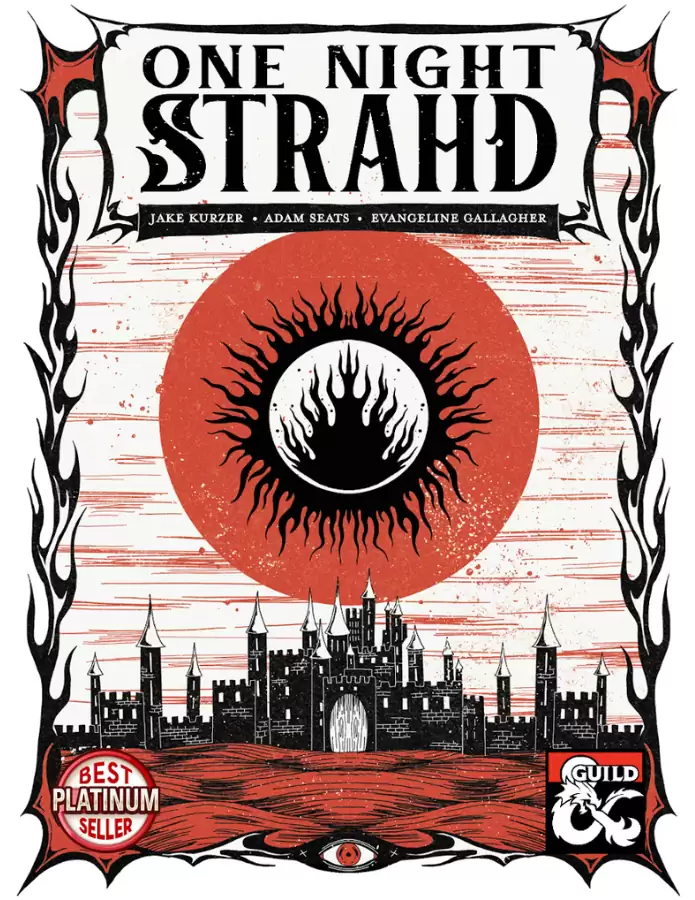
One example of a timeless module that has been adapted over many years is Ravenloft, an adventure set in the titular realm where players are tasked with surviving and defeating the vampire Strahd von Zarovich.24 The most recent official iteration of the adventure for the 5th edition of Dungeons and Dragons, Curse of Strahd, expands the 38-page module into 256 pages of maps, stat blocks, and scenario notes to run a comprehensive 200 hour campaign set in Ravenloft with modern game design leanings.25 As a response to this expansive adventure, One Night Strahd goes into the opposite direction by cutting down the randomisation and dependencies on other materials books to provide a Ravenloft experience that significantly reduces the campaign time to 16 hours.26 Amongst all these deviations, the core of a gothic horror aesthetic, and iconic randomisation of key item locations via randomised cards remains consistent amongst these modules.27
Perhaps the most important iteration happens after the module is published. Each successive GM takes the module’s structure and adapts it on the fly for their playing group, changing the tone, the characterisation, and the order of events according to the needs of their story. To continue with the Curse of Strahd example, simply looking at popular Actual Plays shows a massive deviation: in High Rollers’ playthrough28, a brutal early-game playstyle leads to the death of several characters, whilst the titular Strahd is portrayed in a more complex light and in dialogue with other Dark Powers. In Not Another D&D Podcasts’s playthrough29, though it retains similar characters and structure, the characters become preoccupied with a farcical quest to open a fast food franchise and the GM and players reinterpret beloved characters in a humorous, mocking manner.
Some common points that are often reinterpreted are different characters. Rakugo is defined by stock characters,30 like Yotaro, a simple, carefree man who gets into trouble from misunderstandings.31 Many of these characters appear in different contexts depending on what a story needs: Yotaro in “Praising children” is just an average man looking to try and get a free drink,32 while Yotaro in “Golden Bamboo” is trying to work for his father’s shop, struggling to understand the thick kansai dialect.33 In TTRPGs, these “stock” characters can be seen in the NPC statblocks, such as the classic 1HP commoner, but can also be seen in how each GM will personalise an important character, such as the titular Strahd, in a very different way. Such improvisations can be applied to story, setting, and almost anything else within the TTRPG.
Identically as Rakugoka take classic Koten-Banashi and rearrange, if not fully rewrite, them for their audiences, authors of TTRPGS (including GMs) deviate and adapt to their own needs, engaging in acts of creative storytelling around predetermined points.
Howd o GMs and players decide what must deviate, and what stays the same? A process that seems almost instinctive is, in reality, a very complex one involving some factors which can, again be compared with Rakugo (although not all these elements are usually done consciously).
Firstly, there is a historical and contextual reading of a text. Coming to understand a text’s roots also helps one to understand what can be edited, and how that edit may reverberate though the rest of the text. For example, one might understand Curse of Strahd as emerging both from classic vampire stories like Dracula, from gothic horror in general, old Slavic and Russian folk tales, and from 80s Ravenloft modules (to name but a few). An engaged storyteller looking into these origins could find deeper themes to play with, for example queerness and campness in vampire media, the evolutions of folk tales, and so on. Some game writers and adventure authors indicate their inspirations in their work (such as the famous “Appendix N”) or even blog about them. Mythic Bastionland, for example, lists “Cairn…Kingdoms…Mausritter… op Neverland…Pendragon….Prince Valiant: The Storytelling Game” and “Runecairn” as Selected Inspirations.34 In a similar vein Rakugoka must understand the historical roots of Koten-banashi in how they were originally presented, only then can they explain and adjust them to new audiences.
Additionally, and perhaps most importantly, there is a reading of one’s own audience to think about. Some players like to roleplay, while others like battles and mechanics. Even the same people who are energetic one day may become tired the next, and thus not be as focused. A Rakugoka can sense this from the audience, and will make adjustments to flow and pacing of the story to accommodate their listeners. An energetic Jugemu for an attentive crowd yesterday will be mellow the next if the Rakugoka senses today’s crowd is tired.35
TTRPG adventures often help prepare for this by informing GMs of what kind of game it is, such as through content warnings. Beyond this, it is prudent for a GM to be wise to their players' tastes and moods, where they can select the right game for them or adjust the game for their needs, through communication, reinterpretation and the use of safety tools.37 A player may also engage in these kinds of activity by being sensible to the moods of their fellow participants and adjusting actions on the fly, though this is not the subject of this article.
If we interpret a “traditional” GM’s authority over storytelling as being similar to that of a Rakugoka to their banashi, then perhaps we can consider the traditional Rakugoka’s structured training in empathy (and an understanding that considering others’ needs is a vital part of improvisational artistry, not a compromising cross-current) to be a useful lens through which to understand safety in TTRPGs.
Easing Into The Story
Perhaps one of the most useful and interesting techniques in Rakugo is that of the Makura. Makura literally translates as “pillow”, because it is meant to ease the audience into the story. A Makura is intended to make the Rakugoka be more relatable and thus help the audience receive their story easier.
This idea is not exclusive to Rakugo or even to improvisational or performance based settings. The field of psychology notes the expectations of some social gatherings place the importance on making time to talk before an event starts, or engage in “pre-meeting” talk that helps ease in to the intended productive activity.38 Pre-meeting talk is informally practiced in TTRPG groups, which can be thought of as a social gathering for the purpose of playing a game together.
However, rather than simply being small-talk, the Makura structure is intrinsically connected to the story one is about to tell. M. W. Shores, who analysed many Makura from many performances, defined nine components that were delivered by Rakugoka.39 These can be summarised as follows:
- {1} Greet the audience
- {2} “Feel out” the audience
- {3} Break ice, build rapport
- {4} Establish artistic authenticity
- {5} Present topical material
- {6} Tell jokes,Kobanashi
- {7} Teach about rakugo, elucidate difficult subject matter
- {8} Transport audience to a different time/place
- {9} Set up a smooth transition into theHondai
Applied to the context of a TTRPG session: it is a structured guide for GMs talking to their players, such as how one should: Introduce themselves {1}, do friendly check-ins with the group {2 and 3}, show that they are prepared in terms of tone {4} as well as knowing the game rules {7}. Telling jokes and shorter stories like kobanashi {6} may seem odd and unnecessary, but the intention of this is to build rapport with the audience and of course almost tease the experience. It is similar to sharing anecdotes or making comparisons to pop culture {5} as a way to sell the game, if not hype up the players in preparation of the game. Transitioning to a state where players are focused on the game and its world {7, 8 and 9} is a vital aspect of starting a TTRPG.
Games of all kinds describe “The Magic Circle” as a phenomenon that allows the suspension of disbelief that in turn allows players to enter a game world.40 For Rakugoka helping their audience receive a story: teaching an audience history or myths {7} ensures the context of a banashi is not lost on the audience. Declaring the circumstances under which a banashi takes place {8} is especially important if it refers to historical events – TTRPGs, especially in its roots from simulationist wargames which utilise time, will benefit from this chronological grounding. Finally, with the set up of all the prior aspects, a story can begin {9}. Combining all these components allows a storyteller to warm their audience up and ready them to receive their play.
Table 1 shows a direct comparison of Makura to TTRPG-GM applications. It should be noted that the order of notes presented here should not be taken as absolute rules or a universal application. Depending on status41 and style42 the order of components may be rearranged, removed or simply not even reported, much like how Rakugoka treatsbanashiin general. A specific case for TTRPGs is the application of the “rolling teach”, where rules and context may be brought up at the most relevant moments during play, rather than all at once. Breaking up the rules of play means that {7} of the Makura may be less preferable to apply at the start of a session. Parts {1, 2 and 3} are considered standard practices of care, if not just running a game. The next section aims to elucidate on how this framework is applied to preparatory notes of a TTRPG.
Makura Component |
TTRPG application |
Example |
{1} Greet the audience |
Greeting your fellow players |
“Introduce self” |
{2} “Feel out” the audience |
Check vibe and energy |
“Ask players about themselves, expectations...” |
{3} Break ice, build rapport |
Bring up the energy |
“.../SAFETY: Biological horror, Death, Poison” |
{4} Establish artistic authenticity |
Relay knowledge/experience of the game’s themes |
“One of the most important things I think about in TTRPGs…” |
{5} Present topical material |
Relate ideas to the real world |
“~We’re Knights of the Round table" |
{6} Tell jokes, kobanashi |
Anecdotes, literally telling jokes |
“Who doesn’t love Monty Python?” |
{8} Transport audience to a different time/place |
Set a scene/recap events |
“Opens a triangle shaped book: On cold misten hills, beast witsome and fell…” |
{9} Set up a smooth transition into the hondai |
Opening scene, In medias res |
“Throw them in riding towards Seat of power” |
{7} Teach about rakugo, elucidate difficult subject matter |
Teach mechanics & rules |
“REMEMBER: Primacy of action” |
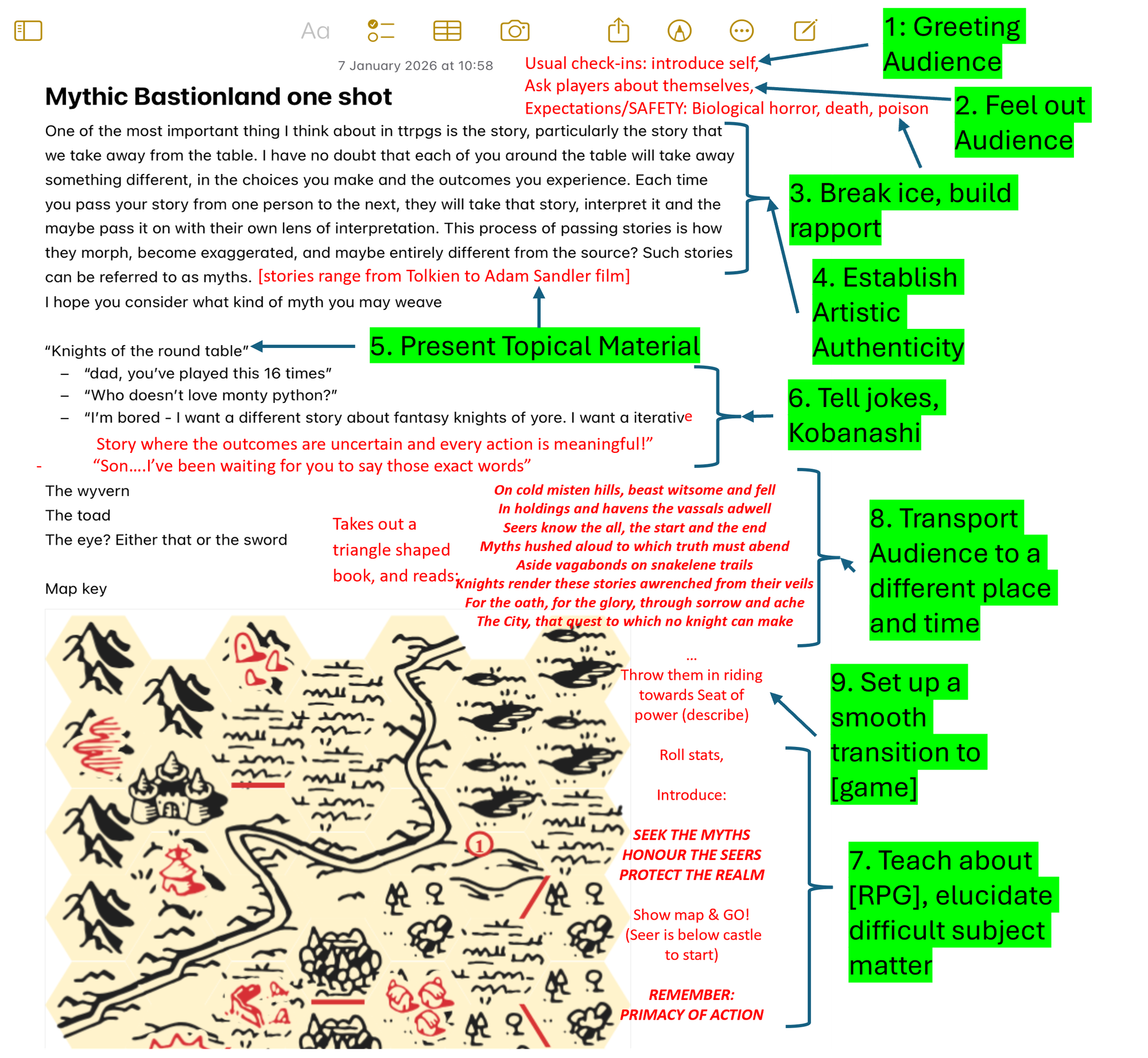
Table 1: A comparison of the components of the Makura, adapted from (Shores 2021), to applications in TTRPGs, and highlights specific examples used in Figure 2 (below).
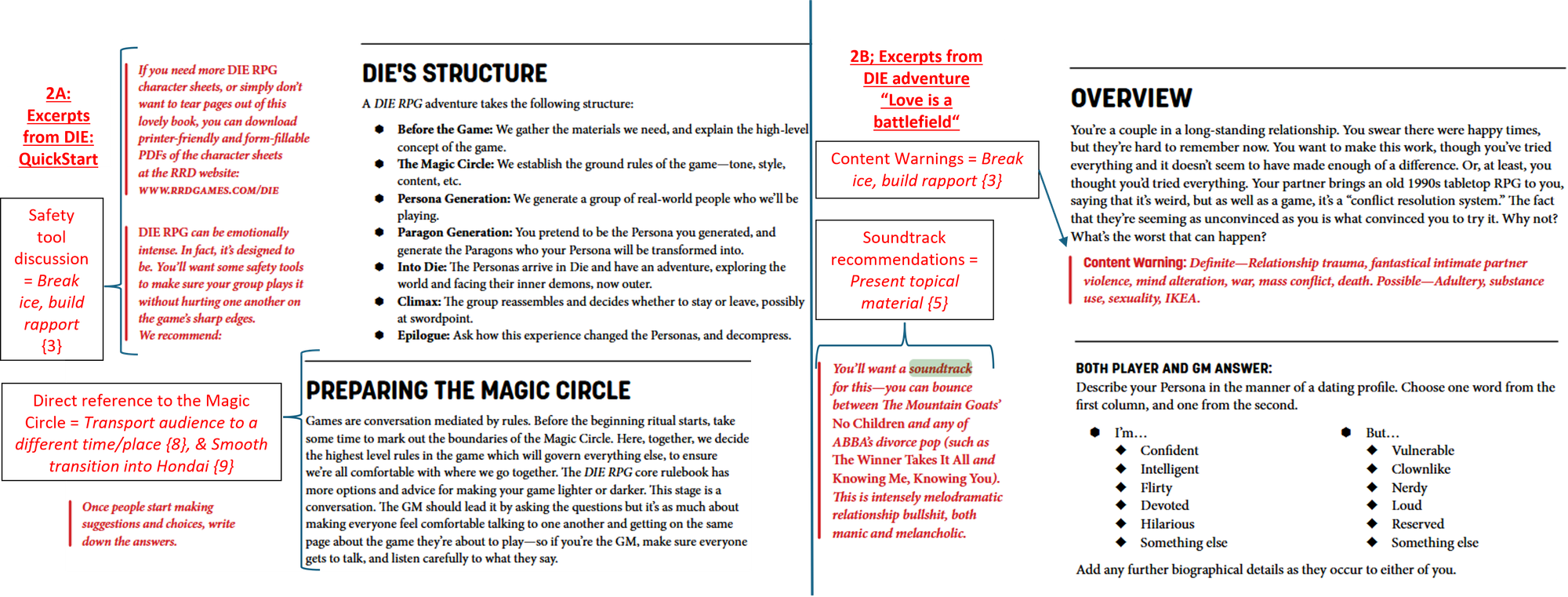
Makura components are already part of game design elements, which can be seen in DIE:The Roleplaying Game43 (Figure 2).
DIE has step-by-step procedures which walk first time players and GMs through the discussion of safety tools {3} as well as a direct reference to entering the Magic Circle {8 and 9} as part of “session zero”, or the character and world building prior to the game.44 Specific adventures also note content warnings at the start {3} and the musical inspirations/soundtrack recommendations present in theLove is a Battlefield45also act as a contextual flagpoint for tone {5}. Considering the nine components of theMakura when writing about how to teach a TTRPG could not only facilitate easier onboarding for players to new games, but also improve the GM’s teaching of a game.
Praxis: A micro-analysis of a Makura-session introduction.
Practically applying the principles of the Makura format to TTRPGs can be seen in Figure 2, a set of preparatory notes for a game of Mythic Bastionland. GM-led games having been established as a style in which Rakugo techniques can be effectively applied, this is practically demonstrated in a live game of Mythic Bastionland.46
The audience for this game was a single session game (a “oneshot”) featuring players who had never played the game before. A feature ofMythic Bastionlandis the “weirdness” of the setting and open interpretation of the gameworld. THis is exemplified, for example, by the entry for the Screaming Seer, whose details are replaced with “RAAAAAARGH!” and “YAAAAAAAAAARRRGH!!!” respectively47, a reading which can be comic or tragic depending on specific interpretation by the GM and players.
Figure 2’s session framework intends for both tones to be expressed. The paragraph in the middle {4} can be most directly compared to a Makura, in that it sets the scene for how Mythic Bastionland is about myths, how the players are the ones directing the story, and the range of stories that can be told. Following this introduction: the pre-story/kobanashi{5} expands on the theme of myths through the framing of Mythic Bastionlandbeing a child’s bedtime story. The reference toMonty Python and the Holy Grail{6} is a comedic connection to fantastical knights of yore, which in turn leads to a dramatic reading of the first rhyming couplets in the book {8}.48 Applying a makura framework as shown in Figure 1, provides an attempt to present this nuanced, kaleidoscopic, tone.
Ochi: rounding out stories through the study of life
The applications and ideas presented in this article may not be suited for all game tables. Rakugo arts and methods being applied to the practice of running TTRPGs comes from a perspective that treats TTRPGs, very specifically, as stories to be told.
While I agree with this view, it does not therefore follow that one must blindly apply the story structures of Rakugo to TTRPGs. Rather, I am of the view that TTRPG adventures are connected experiences from which a story can derive.49 The artistry within TTRPGs emerges not only from the module, but from the improvisation provided by the GM and the players, just as, while there is a kind of “transferred” or historically embedded artistry in the koben-bananshi, much of the art of Rakugo comes from the improvisation of the performer.
To that end, the study of rigid structures may seem counterintuitive to apply to TTRPGs, and other performance arts like improv may be better suited to create these experiences. So why study Rakugo if you are only studying stories? The answer, I posit, is that one must study Rakugo because of what is required to tell stories.
Beyond all the defined structures of Rakugo, mastery of the performance art is quintessentially the study of life. Referring back to Scared of Manju/Hamburgers, a zenza banashi (meaning one of the first stories a Rakugoka learns), involves a scene depicting manju or burgers being eaten. Consider: how would you depict eating food? Western readers will have a presumed knowledge of hamburgers, but what about Japanese sweet buns with sweet filling? Knowing the different flavours, which ones have a gooey or firm filling, and being able to depict the gastronomical side of eating foods can be a defining feature of a performance.50 This of course can only be experienced by understanding what manju (or burgers) are like as food and through practicing eating them.
As has been discussed earlier, one can align the idea of Rakugo’s sābisu with GMing as an act of service, and with certain perspectives on table safety; in the Mothership Warden’s Guide, for example,this is described as the essentiality of "hospitality":
You need to be graceful and understanding and you need to listen to the other players. In addition to all the other social requirements of being a human in a shared space with other humans you need that basic human requirement of kindness.51
I am not suggesting GM’s should feel like indentured servants to learn their craft better. Sābisu should be treated as a belief in providing the best kind of experience for an audience because of the pride in a creator’s art – by serving the people around oneself, that person is in turn serving themselves.
What TTRPG practitioners can learn from Rakugo (individual performance skills, critical reading of modules, and prepared introductions) is presented here with theory and evidenced examples. The “punchline” is that TTRPG storytellers who want to provide (and participate in) the best possible experiences should study hard, and the simplest way to do this is to study the world around oneself. One may learn about characterisation from observing others, or setting and atmosphere by researching the history of a genre, but by far the most underrated of all of these is close observation of one’s fellow players; their moods, skills, and predilections. If a GM is working hard and motivated to bring joy to the people around the table, then they already have the mindset of a Rakugoka.
Biography
D “Zhen (pronounced Chun)” C is a PhD in Genetic Epidemiology. A lifelong fan of games, the first RPG he ever ran and played in was Goblin Quest in 2017. Since then, he’s completed a Dungeons and Dragons 5e campaign across 6 years from 2019 to 2025, run his first campaign of Slugblaster between 2025-26, along with occasional one-shots of Dog Eat Dog, Golden Sky Stories, and Wanderhome, to name a few of his favourites. He has become a regular GM and player within the Quinns Quest Discord community. D owes his degree to the RPG community, as a form of practicing public speaking which helped him defend his thesis. The only credit to his name at this point of time is a design contribution to Slugblaster’s Book of Solder. He likes to cook in his spare time and go for mid distance runs.
Bibliography
A. Allen, Joseph, Nale Lehmann-Willenbrock, and Nicole Landowski. "Linking Pre-Meeting Communication to Meeting Effectiveness."Journal of Managerial Psychology29, no. 8 (2014): 1064–1081. doi:10.1108/JMP-09-2012-0265. https://www.proquest.com/docview/2138087809.
Agency for Cultural Affairs, Government of Japan. , 1995, last modified May 31"Rakugo: Nationally Designated Cultural Property, Etc.", accessed Aug 20, 2026, https://kunishitei.bunka.go.jp/heritage/detail/303/39.
Akane-banashi Global. , 2026a, last modified Jun 12"TV Anime "Akane-Banashi" Akane "Jugemu" Rakugo Scene." Youtube., accessed Sep 4, 2026, https://www.youtube.com/watch?v=ZEZU03ZCQu8.
Akane-banashi Global. , 2026b, last modified May 28"TV Anime "Akane-Banashi" Karashi Nerimaya "BM" Rakugo Scene_Episode8." Youtube., accessed Aug 21, 2026, https://www.youtube.com/watch?v=XBn3jxuOFsY&pp=ygUJQk0gcmFrdWdv.
Bedtime History. , 2022, last modified Jan 11"History of J.R.R. Tolkien for Kids | Bedtime History: Podcast and Videos for Kids | Homework Help.", accessed Aug 24, 2026, https://bedtimehistorystories.com/history-of-j-r-r-tolkien-for-kids/.
Bieker, Tobias. , 2025, last modified May 24"How Katsura Sunshine Brought Japanese Comedy to Broadway.", accessed July 20, 2026, https://www.youtube.com/watch?v=nfEBqkhAL0c.
Blandy, David. , 2026, last modified Jul 4"How to Write an OSR Adventure." David B.'s Newsletter., accessed July 30, 2026, https://davidblandy.substack.com/p/how-to-write-an-osr-adventure.
Chulick, Devon, Davis, Elliot and Flaherty, Brian. , 2025, last modified Nov 26 Many Sidede Media"Making GMs Over 50 Million Dollars (W/ Devon Chulick)." Youtube., accessed Aug 21, 2026, https://www.youtube.com/watch?v=_64Nm8hsTOk.
Dragon, Jay.Wanderhome. 1st ed. Possum Creek Games, 2021.
Eishi, Kanariya. , 2026, last modified Feb 4"Eishi’s Rakugo Commentary no.5 [Peach Boy桃太郎].", accessed July 16, 2026,https://rakugonz.com/2026/02/04/eishis-rakugo-commentary-no-5-peach-boy-%E6%A1%83%E5%A4%AA%E9%83%8E/.
Friedman, Em and Lee Mulligan, Brennan. , 2026, last modified Jul 30"A Duty of Care (with Dr. Emily Friedman) | Adventuring Academy Season 7 | Ep. 6." Dropout., accessed Aug 21, 2026, https://www.youtube.com/watch?v=0AF66E4G75Q.
Gillen, Kieron.DIE the Roleplaying Game Quickstart. Rowan, Rook & Decard, 2026.
Gillen, Kieron, Stephanie Hans, Kienna Shaw, et al.DIE the Roleplaying Game. Rowan, Rook & Decard, 2023.
Gillen, Kieron, Zedeck Siew, and Basheer Ghouse.Love is a Battlefield: DIE RPG: Scenarios Vol. 2. Rowan, Rook & Decard, 2024.
Hedra Group, The , Jake Kurzer, Adam Seats, et al.One Night Strahd. DM's Guild, 2021.
Hibbett, Howard,策 伝 安楽庵, and H. Mack Horton.Laughs to Banish Sleep : Selections from Seisuishō (1623). Highmoonoon, 2001.
Hickman, Tracy, Laura Hickman, and Clyde Caldwell.I6 Ravenloft. TSR, 1983.
Hulmes, Mara, Venandi, Rose, Morrison, Katie, et al. , 2023, last modified Aug 8"High Rollers: Curse of Strahd (5e D&D Module).", accessed Sep 7, 2026, https://www.youtube.com/playlist?list=PLHv5CBoZYv4Xu9oFWXFizxBv8zsmlaOa3.
Kamiya, Ryo, Tsugihagi Honpo, and Ewen Cluney.Golden Sky Stories. English ed. Starline Publishing, 2013.
Kouseinen, Sanyutei. , 2025, last modified Aug 12 Youtube"Traditional Japanese Comedic Theatre Rakugo in English - "Momotaro" (古典落語「桃太郎」英語版).", accessed July 16, 2026,https://www.youtube.com/watch?v=R1eGcKZJPqw.
Lee Mulligan, Brennen e. a. , 2026, last modified Aug 13"Dimension 20." Dropout., accessed Aug 21, 2026, https://www.youtube.com/dimension20show.
Linser, Roni, Nina Ree-Lindstad, and Tone Vold. "The Magic Circle-Game Design Principles and Online Role-Play Simulations."ED-MEDIA 2008--World Conference on Educational Multimedia, Hypermedia & Telecommunications Vienna, Austria(2008).
McCOY, SEAN, JARRETT CRADER, DONN STROUD, et al.Mothership Warden's Guide, 2023.
McDowall, Chris. , 2022, last modified Jul 5"Bastionland: Mythic Bastionland Playtest." Bastionland Blog., accessed Aug 24, 2026, https://www.bastionland.com/2022/07/primeval-bastionland-playtest.html.
McDowall, Chris, Alec Sorensen, and Sarah Acton.Mythic Bastionland, 2025.
Mercer, Matthew e. a. , 2026, last modified Aug 17"Critical Role." Critcal Role., accessed Aug 21, 2026, https://critrole.com/.
Morioka, Heinz, and Miyoko Sasakiv.Rakugo: The Popular Narrative Art of Japan. Harvard University Asia Center, 1990. https://www.vlebooks.com/vleweb/product/openreader?id=none&isbn=9781684172764.
Murphy, Brian, Axford, Emily, Tanner, Cauldwell, Hurwitz, Jake and Ramos, Daniel. , 2025, last modified Jun 20"Trinyvale X Strahd - Ep. 1: Into the Mists.", accessed Sep 7, 2026, https://podcasts.apple.com/us/podcast/trinyvale-x-strahd-ep-1-into-the-mists/id1344003690?i=1000713815062.
O'connel, Laurie. 2026.Discord Call with AuthorAnonymous , edited by Daniel Chin.
O'Connel, Laurie. , "Excerpts - Laurie O'Connel.", accessed Aug 24, 2026, https://laurieoconnel.com/excerpts.
Ohkubo, Kristine, and Kanariya Eiraku.Talking about Rakugo 1: The Japanese Art of Storytelling. Second edition ed. IngramSpark, 2022.
Perkins, Chris, Tracy Hickman, Laura Hickman, Adam Lee, Richard Whitters, and Jeremy Crawford.Curse of Strahd, 2016.
Rabinowitz, Chloe. , 2026, last modified June 29"KATSURA SUNSHINE'S RAKUGO to Play Final Performance Off-Broadway." Broadway World., accessed 15/07, 2026, https://www.broadwayworld.com/article/KATSURA-SUNSHINES-RAKUGO-to-Play-Final-Performance-Off-Broadway-20260629.
Shaw, Kienna and Bryant-Monk, Lauren. , 2023, last modified Aug 25"TTRPG Safety Toolkit.", accessed Aug 24, 2026, https://ttrpgsafetytoolkit.com/.
Shiguma Museum. , 2025, last modified Apr"落語展_コラム英語_QR -落語展_コラム英語_QR.Pdf.", accessed Aug 25, 2026,https://www.shigamuseum.jp/wordpress/wp-content/uploads/2025/04/%E8%90%BD%E8%AA%9E%E5%B1%95_%E3%82%B3%E3%83%A9%E3%83%A0%E8%8B%B1%E8%AA%9E_QR.pdf.
Shores, M. W.The Comic Storytelling of Western Japan : Satire and Social Mobility in Kamigata Rakugo. Cambridge University Press, 2021a. doi:10.1017/9781108917476. http://hdl.handle.net/2078/ebook:311239.
Shores, M. W. "Everybody’s Comfier with a Good Pillow."Asian Theatre Journal38, no. 2 (2021b): 462–487. doi:10.1353/atj.2021.0030. https://www.jstor.org/stable/27120496.
Shores, M. W. "Japanese Gastronomic Imagination through Rakugo Performance."Food, Culture, & Society29, no. 3 (2026): 879–897. doi:10.1080/15528014.2025.2594808. https://www.tandfonline.com/doi/abs/10.1080/15528014.2025.2594808.
Suenaga, Yuki, Takamasa Moue, and Keiki Hayashiya.Akane-Banashi, Vol. 2. Viz Media, 2023.
Suenaga, Yuki, Takamasa Moue, and Keiki Hayashiya.Akane-Banashi, Vol. 8. Viz media, 2024.
Uncaged Authors. , 2022, last modified Feb 23 "Uncaged Anthology: Godessess DM's Guild Page." DM's Guild., accessed Aug 21, 2026, https://www.dmsguild.com/en/product/382873/uncaged-goddesses.
Uncaged Authors. , "Uncaged Authors Adventure Format Template." Google docs., accessed Aug 24, 2026, https://docs.google.com/document/d/1bcvNq7amJjWY0hKrUyMS3zN7yW_oQJ0sU1D2zrNhMI4/edit?tab=t.0#heading=h.30j0zll.
Footnotes
1Hibbett, Howard,策 伝 安楽庵, and H. Mack Horton.Laughs to Banish Sleep : Selections from Seisuishō (1623). Highmoonoon, 2001.
2 Shores, M. W.The Comic Storytelling of Western Japan : Satire and Social Mobility in Kamigata Rakugo. Cambridge University Press, 2021. doi:10.1017/9781108917476. http://hdl.handle.net/2078/ebook:311239.
3 Morioka, Heinz, and Miyoko Sasakiv.Rakugo: The Popular Narrative Art of Japan. Harvard University Asia Center, 1990. https://www.vlebooks.com/vleweb/product/openreader?id=none&isbn=9781684172764.
4 Though venues can be as grand as theNew World Stagesin New York’s Broadway.
5 Agency for Cultural Affairs, Government of Japan. , 1995, last modified May 31. "Rakugo: Nationally Designated Cultural Property, Etc.", accessed Aug 20, 2026, https://kunishitei.bunka.go.jp/heritage/detail/303/39.
6Shores, M. W.The Comic Storytelling of Western Japan : Satire and Social Mobility in Kamigata Rakugo. Cambridge University Press, 2021. doi:10.1017/9781108917476. http://hdl.handle.net/2078/ebook:311239.
7 Morioka, Heinz, and Miyoko Sasakiv.Rakugo: The Popular Narrative Art of Japan. Harvard University Asia Center, 1990. https://www.vlebooks.com/vleweb/product/openreader?id=none&isbn=9781684172764.
8 Davis, Elliot, Flaherty, Brian, Smith, Quentin, Brennan Lee Mulligan, and Emily Friedman. 2025.Roundtable: Teaching Games through Actual Play (Ft. Brennan Lee Mulligan, Quinns, and Dr. Emily Friedman). Talk of the Table. Many Sided Mediahttps://www.youtube.com/watch?v=ch8HoQhg-gQ.
9Shores, M. W.The Comic Storytelling of Western Japan : Satire and Social Mobility in Kamigata Rakugo. Cambridge University Press, 2021. doi:10.1017/9781108917476. http://hdl.handle.net/2078/ebook:311239.
10Edo Rakugoperformers have historically found such accessories less palatable, preferring to focus on the strength of the performer. This means thatEdo Rakugoversions of the same stories tend to be shorter, and music rarely ever plays in the middle of a performance.
11 Kamiya, Ryo, Tsugihagi Honpo, and Ewen Cluney.Golden Sky Stories. English ed. Starline Publishing, 2013.
12 Such a mindset is also most crucial for Professional GMs: individuals who offer their services for a fee to groups of people who gather for the explicit purpose of playing a TTRPG. The Professional GM format is closer to the conditions and expectations to those a Professional Rakugoka faces. However, the conditions that Professional Rakugoka train under (years of indentured servitude, promotion exams, and story mastery limited by in-person lessons) are not the only form of learning Rakugo. Universities have amateur Rakugo clubs which are less strict. This is more in line with the average TTRPG hobby space facilitated through informal gatherings and clubs rather than financial transactions or public actual play. By this metric of amateur gatherings, learning the art of Rakugo can be considered very similar to TTRPGs. For the purposes of comparing Rakugo as an art and TTRPG GameMastering, this article will be focusing on the amateur spaces for both fields.
13 This is especially true before Actual Play media or replays became mainstream or accessible.
14 Bieker, Tobias. , 2025, last modified May 24"How Katsura Sunshine Brought Japanese Comedy to Broadway.", accessed July 20, 2026, https://www.youtube.com/watch?v=nfEBqkhAL0c.
15Blandy, David. , 2026, last modified Jul 4"How to Write an OSR Adventure." David B.'s Newsletter., accessed July 30, 2026, https://davidblandy.substack.com/p/how-to-write-an-osr-adventure.
16 Eishi, Kanariya. , 2026, last modified Feb 4"Eishi’s Rakugo Commentary no.5 [Peach Boy桃太郎].", accessed July 16, 2026,https://rakugonz.com/2026/02/04/eishis-rakugo-commentary-no-5-peach-boy-%E6%A1%83%E5%A4%AA%E9%83%8E/.
17 Ohkubo, Kristine, and Kanariya Eiraku.Talking about Rakugo 1: The Japanese Art of Storytelling. Second ed. IngramSpark, 2022.
18 Kouseinen, Sanyutei. , 2025, last modified Aug 12 Youtube"Traditional Japanese Comedic Theatre Rakugo in English - "Momotaro" (古典落語「桃太郎」英語版).", accessed July 16, 2026,https://www.youtube.com/watch?v=R1eGcKZJPqw.
19 Akane-banashi Global. , 2026, last modified May 28"TV Anime "Akane-Banashi" Karashi Nerimaya "BM" Rakugo Scene_Episode8." Youtube., accessed Aug 21, 2026, https://www.youtube.com/watch?v=XBn3jxuOFsY&pp=ygUJQk0gcmFrdWdv.
20 Ohkubo, Kristine, and Kanariya Eiraku.Talking about Rakugo 1: The Japanese Art of Storytelling. Second ed. IngramSpark, 2022.
21Blandy, David. , 2026, last modified Jul 4"How to Write an OSR Adventure." David B.'s Newsletter., accessed July 30, 2026, https://davidblandy.substack.com/p/how-to-write-an-osr-adventure.
22 Uncaged Authors. , "Uncaged Authors Adventure Format Template." Google docs., accessed Aug 24, 2026, https://docs.google.com/document/d/1bcvNq7amJjWY0hKrUyMS3zN7yW_oQJ0sU1D2zrNhMI4/edit?tab=t.0#heading=h.30j0zll.
23 O'Connel, Laurie. , "Excerpts - Laurie O'Connel.", accessed Aug 24, 2026, https://laurieoconnel.com/excerpts.
24Hickman, Tracy, Laura Hickman, and Clyde Caldwell.I6 Ravenloft. TSR, 1983.
25Perkins, Chris, Tracy Hickman, Laura Hickman, Adam Lee, Richard Whitters, and Jeremy Crawford.Curse of Strahd, 2016.
26Hedra Group, The, Jake Kurzer, Adam Seats, et al.One Night Strahd. DM's Guild, 2021.
27The scope of these statements is limited in understanding the depth of the deviations from the original Ravenloft, given this is only one DM’s Guild pdf analysis of the 1177 currently present on the DM’s Guild database, let alone independent blogs and social media groups that have shared theories and ideas of how to run.
28Hulmes, Mara, Venandi, Rose, Morrison, Katie, et al. , 2023, last modified Aug 8"High Rollers: Curse of Strahd (5e D&D Module).", accessed Sep 7, 2026, https://www.youtube.com/playlist?list=PLHv5CBoZYv4Xu9oFWXFizxBv8zsmlaOa3.
29 Murphy, Brian, Axford, Emily, Tanner, Cauldwell, Hurwitz, Jake and Ramos, Daniel. , 2025, last modified Jun 20"Trinyvale X Strahd - Ep. 1: Into the Mists.", accessed Sep 7, 2026, https://podcasts.apple.com/us/podcast/trinyvale-x-strahd-ep-1-into-the-mists/id1344003690?i=1000713815062.
30 Shiguma Museum. , 2025, last modified Apr"落語展_コラム英語_QR -落語展_コラム英語_QR.Pdf.", accessed Aug 25, 2026,https://www.shigamuseum.jp/wordpress/wp-content/uploads/2025/04/%E8%90%BD%E8%AA%9E%E5%B1%95_%E3%82%B3%E3%83%A9%E3%83%A0%E8%8B%B1%E8%AA%9E_QR.pdf.
31 Ohkubo, Kristine, and Kanariya Eiraku.Talking about Rakugo 1: The Japanese Art of Storytelling. Second ed. IngramSpark, 2022.
32 Suenaga, Yuki, Takamasa Moue, and Keiki Hayashiya.Akane-Banashi, Vol. 2. Viz Media, 2023.
33 Suenaga, Yuki, Takamasa Moue, and Keiki Hayashiya.Akane-Banashi, Vol. 8. Viz media, 2024.
34 McDowall, Chris, Alec Sorensen, and Sarah Acton.Mythic Bastionland, 2025.
35 Akane-banashi Global. , 2026, last modified Jun 12"TV Anime "Akane-Banashi" Akane "Jugemu" Rakugo Scene." Youtube., accessed Sep 4, 2026, https://www.youtube.com/watch?v=ZEZU03ZCQu8.
36 McCOY, SEAN, JARRETT CRADER, DONN STROUD, et al.Mothership Warden's Guide, 2023.
37 Shaw, Kienna and Bryant-Monk, Lauren. , 2023, last modified Aug 25"TTRPG Safety Toolkit.", accessed Aug 24, 2026, https://ttrpgsafetytoolkit.com/.
38 A. Allen, Joseph, Nale Lehmann-Willenbrock, and Nicole Landowski. "Linking Pre-Meeting Communication to Meeting Effectiveness."Journal of Managerial Psychology29, no. 8 (2014): 1064–1081. doi:10.1108/JMP-09-2012-0265. https://www.proquest.com/docview/2138087809.
39 Shores, M. W. "Everybody’s Comfier with a Good Pillow."Asian Theatre Journal38, no. 2 (2021): 462–487. doi:10.1353/atj.2021.0030. https://www.jstor.org/stable/27120496.
40 Linser, Roni, Nina Ree-Lindstad, and Tone Vold. "The Magic Circle-Game Design Principles and Online Role-Play Simulations."ED-MEDIA 2008--World Conference on Educational Multimedia, Hypermedia & Telecommunications Vienna, Austria(2008).
41 The most junior performers,Zenza, go first and are expected to only perform a story, having no time for makura. A headlinerShin’uchiperformer is expected to have a Makura, but not always.
42 Katsura Mikisuke III was noted for reciting a haiku for his performance ofShibahama, translated as: “Early dawn/ Whitefish, whiteness/ Three centimeters long”. The reference to Whitefish intends to transfer the audience back to the time {8} when the beach of Shiba, the setting, had such fish (Shores 2021)
43Gillen, Kieron, Stephanie Hans, Kienna Shaw, et al.DIE the Roleplaying Game. Rowan, Rook & Decard, 2023.
44 Gillen, Kieron.DIE the Roleplaying Game Quickstart. Rowan, Rook & Decard, 2026.
45 Gillen, Kieron, Zedeck Siew, and Basheer Ghouse.Love is a Battlefield: DIE RPG: Scenarios Vol. 2. Rowan, Rook & Decard, 2024.
46 Mythic Bastionland is highly flexible with game styles, rooted in Old School Renaissance, or OSR for short. OSR is associated with the traditionalist mindset for running games but Mythic Bastionland is modern for its guided procedures that create evocative encounters with minimal preparation. The example shown here intends to highlight the flexibility and utility of Makura in more than just the traditional game format.
47 McDowall, Chris, Alec Sorensen, and Sarah Acton.Mythic Bastionland, 2025.
48As a post-session critical reflection: more effort could have been made to explicitly emphasise the varied tone through the analogy of bedtime stories. The note of “Stories range from Tolkien to Adam Sandler” was a direct reference to how J.R.R Tolkien’s The Hobbit was based on the bedtime stories told to his son, along with the film Bedtime Stories starring Adam Sandler, a family comedy about how the bedtime stories a father tells to kids metaphysically affect his everyday life. Directly mentioning this would have tied into why this was formatted as a story within a story, and would have provided a more grounded framework for the varied tone.
49 Blandy, David. , 2026, last modified Jul 4"How to Write an OSR Adventure." David B.'s Newsletter., accessed July 30, 2026, https://davidblandy.substack.com/p/how-to-write-an-osr-adventure.
50 Shores, M. W. "Japanese Gastronomic Imagination through Rakugo Performance."Food, Culture, & Society29, no. 3 (2026): 879–897. doi:10.1080/15528014.2025.2594808. https://www.tandfonline.com/doi/abs/10.1080/15528014.2025.2594808.
51 McCOY, SEAN, JARRETT CRADER, DONN STROUD, et al.Mothership Warden's Guide, 2023.