
Determining a Melodramatic Sensibility in Tabletop Role-playing Games
Kayla Dice presents an argument for the existence of a developing melodramatic sensibility within TTRPGS, based on the analytic criteria of heightened emotionality, pathos, and meaningful dichotomies.
The term “melodrama” originates from Victorian stage dramas that integrated musical accompaniment into the action. The term broadened over time, unlinking from music and expanding into film and television; today, most dictionary definitions reference strong or exaggerated emotions and exciting events as its defining characteristics. There can be a pejorative dimension to the term in modern usage—the suggestion that someone is “being melodramatic” is frequently used to discount an emotional response. However, film studies has long treated melodrama as an object of serious study. There is no rigidly fixed definition for melodrama within film studies: it has been conceived of as a genre, a cinematic style, and a sensibility.
Cinematic style is obviously too medium-specific to be of primary use to tabletop role-playing game (TTRPG) analysis, and relying strictly on genre definitions of melodrama would require narrowing our focus to a very specific text or subgenre. However, the melodramatic sensibility, melodrama as a mode of expression, as articulated by Peter Brooks in The Melodramatic Imagination,1 is both present and remarkably popular in modern TTRPGs.
This article proposes a framework of three essential elements that constitute melodrama in TTRPGs: heightened emotionality, pathos, and impactful dichotomies. These elements may be contained within a game’s fiction (expressed through portrayals, characterisations, and narrative events) or influenced formally through mechanics, procedures, phases, and rules. Not every text mentioned in this article is inherently a melodrama, though all are susceptible to the melodramatic sensibility.
Their inclusion here is not intended to assert that these games innovated the techniques they use; rather, they were selected because they are all games that I have both read and played, allowing me to attest directly to their inherent or potential melodrama.
Heightened Emotionality
Given its centrality to most working understandings of melodrama as involving strong or exaggerated feelings, starting with heightened emotionality is essential.
Exaggeration or strength first raises the question of what is considered “normal” emotionality. One must apply a contextual understanding to this question, bearing in mind what Christine Gledhill stated in her formative text, “The Melodramatic Field: An Investigation”:
“As the systems of explanation which ground realism change—sociology, Marxism, psychology, economics, phenomenology, existentialism, feminism and so on—the codes and conventions of realism shift in pursuit of new 'truth' and greater 'authenticity'.”2
Changing cultural contexts consistently create new baselines that define whether an emotional expression is perceived as realistic or exaggerated. Consider a scene introducing a player character’s parent: imagine the Game Master (GM) introduces the parent by having them hug their offspring and express how deeply they have missed them. Whether this emotional display feels realistic or exaggerated depends entirely on the cultural context of both the game text and the play group.
Many players default to exaggerating emotional responses to create a memorable and distinct character within the timeframe offered by a single gaming session, even if the text gives no explicit expectations around performance. However, in melodrama, emotions are specifically intense and powerful for those experiencing them, rather than merely exaggerated for external spectators. Ruby McGuigan, introducing a BFI retrospective on melodrama, characterised the mode as having a specific concern with “emotions too volatile for everyday life, and their inevitable explosion under pressure.”3
[Melodrama has] a specific concern with “emotions too volatile for everyday life, and their inevitable explosion under pressure.”
A game text may encourage heightened emotionality simply through principles, performance advice, and character descriptions:
- Monsterhearts repeatedly refers to the main characters' lives as “messy” and encourages reading skin introductions in an over-the-top, explicitly melodramatic fashion.4
- Tales from the Spectral Sea uses emotive language throughout its prose, labeling its ghostly protagonists as “sad” on the cover tagline and stating that the game is designed for telling “heartbreaking” stories.5
Exaggeration crosses a threshold and becomes heightened not just through player performance but through narrative focus, but always operating in relationship to a shifting, subjective social construct.
Easier to identify is when an TTRPG text incorporates mechanically heightened emotionality:
- Strings in Monsterhearts “represent the emotional power that you have over others”.6 They heighten the emotional dimension of relationships and make these feelings mechanically impactful, allowing players to worsen consequences by inflicting Conditions or intensifying Harm.
- Masks: A New Generation features five Conditions that all refer to specific emotional states (Afraid, Angry, Guilty, Hopeless, and Insecure). Marking a Condition inflicts a -2 penalty to specific action rolls. Emotionality is heightened directly because a character's overwhelming feelings alter their probability of success.7
- Trauma Conditions in Blades in the Dark, gained by maxing out Stress, frequently cite heightened emotional states (Unstable denotes a volatile state, while Soft means becoming weak with sentimentality). Playing a character as overwhelmed by these emotional issues rewards experience points, turning emotional struggle into a primary vector for character growth. Interestingly, in contrast to games that demand emotional honesty, Blades notes: “You can play your Trauma conditions as much or as little as you like.”8
- Moves in Tales from the Spectral Sea operate by “rolling with the questions,” where affirmative answers grant bonuses. Many questions for basic moves center on emotion; for instance, Conceal Your Form and Intentions asks, “Are you genuinely afraid of being caught?” The presence of an emotional dimension directly increases a character's chance of mechanical success.
We can draw a clear contrast between mechanically heightened emotionality and mechanics that prioritise physical realities or tactical facts. The melodramatic sensibility thrives on the former because, as Gledhill asserts, it “attests to forces, desires, fears which, though no longer granted metaphysical reality, nevertheless appear to operate in human life independently of rational explanation.”9
While heightened emotionality is melodrama's most distinctive element, its presence alone does not guarantee a melodramatic mode. Heightened emotionality without pathos or impactful dichotomies often creates a comedic sensibility through incongruous emotional responses.
Playtest Material is a young magazine which needs reader support. If you are enjoying this article, consider subscribing to our print magazine, which is what allows us to pay our writers and maintain hosting fees. You still have a few weeks to subscribe in order to receive Issue One in your mailbox when it releases. If that's too much to ask right now, consider signing up for updates or even grabbing a supporter subscription here on our website.
Pathos
Heightened emotionality connects directly to our second essential element, pathos: the invocation of sympathetic pity. Gledhill suggests that melodrama’s “central protagonists become objects of pathos because they are constructed as victims of forces that lie beyond their control and understanding.”10
To give just one example, searching social media for “DND memes” related to backstories it seems the two most common adjectives are tragic or traumatic. This may be a tongue-in-cheek example but it demonstrates that players have a tendency to form an attachment to their characters by sympathising with their suffering. This can be entirely player driven, though some texts will use formal elements such as character creation procedures to create inherent pathos to all player characters:
- Every character in Tales from the Spectral Sea is created with two Traumas, which explicitly stopped them from properly passing on.
- Every player character in Monsterhearts is a teenager who is secretly a monster, and all must grapple with “the terror and confusion of having a body that is changing without your permission”.
Pathos is not merely contained to off-screen history. As Linda Williams stated in Melodrama Revisited, the sensibility “involves a dialectic of pathos and action—a give and take of ‘too late’ and ‘in the nick of time.’”11 Games where suffering is paired with a mechanical reward are an instance of this dialectic in RPGs. The stress system in Blades in the Dark, for example, allows players to mark stress to “push” their character, suffering in exchange for a greater effect.
When analysing RPGs it would be a mistake to treat “action” as a synonym for “combat”, and miss the wider application of this dialectic when considering personal action. In Dream Askew & Dream Apart Weak Moves spotlight a “character’s vulnerability, folly, or even just plain rotten luck” and grant a token, while Strong Moves spotlight their “skill, power, astute planning, or good luck” and allow them to transform a situation but require a token to be spent.
Characters begin with no tokens. The text explains that this token economy creates “a narrative rhythm by ensuring that characters experience complications, stumbling blocks, and mistakes made as they work toward their victories and accomplishments.”12 This is Williams’ dialectic of pathos and action given explicit mechanical weight.
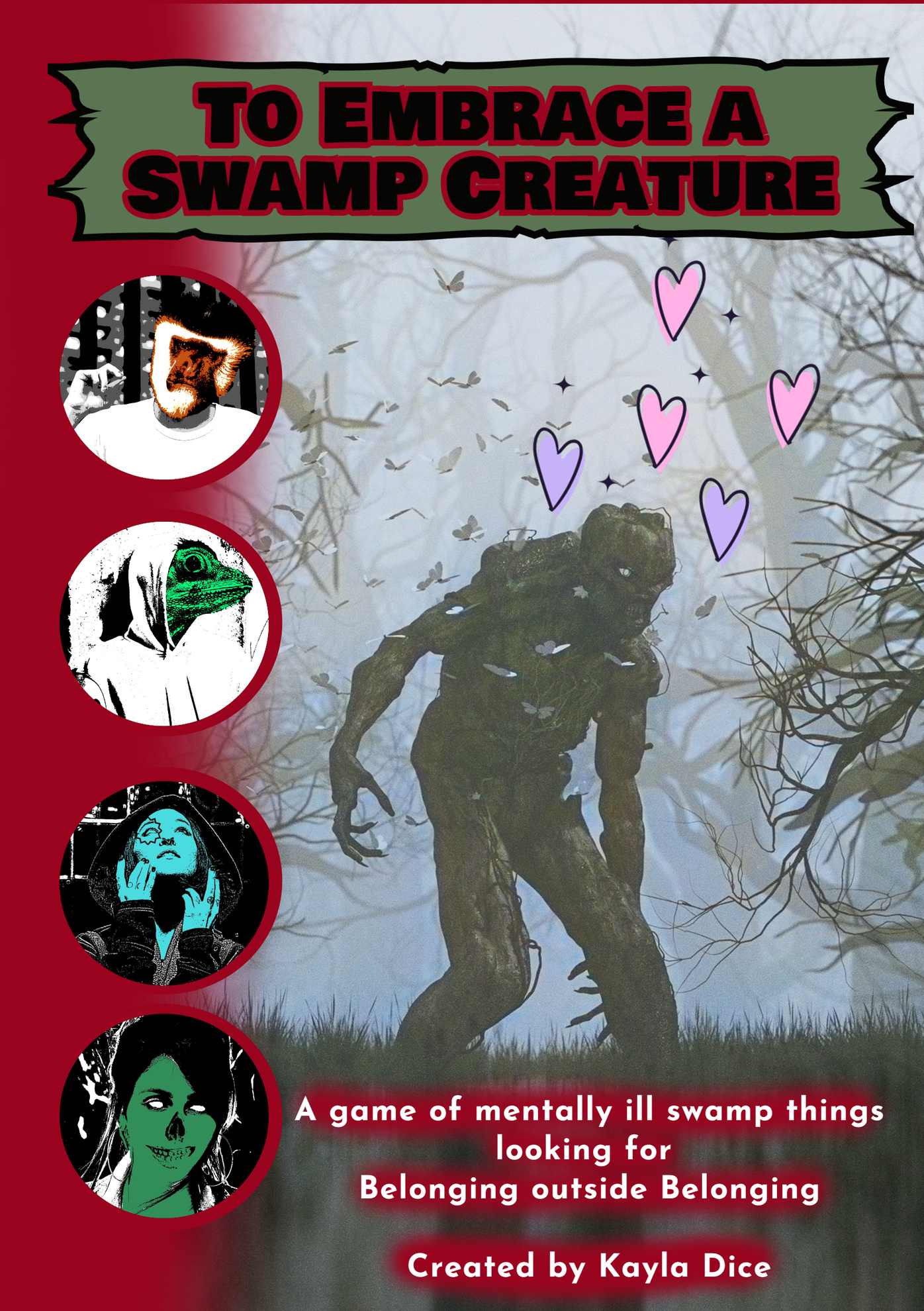
In my own game, To Embrace a Swamp Creature, which adapts the Belonging Outside Belonging framework, Vulnerable Moves (renamed from Weak Moves) center on becoming overwhelmed by intense emotion (e.g., the Sporeling’s move, Project your insecurities).13 Heightened emotionality feeds into pathos by emphasising internal suffering, while pathos heightens emotional impact by linking events to personal struggles.
Impactful Dichotomies
Williams, building on Brooks, asserts that “melodrama is most centrally about moral legibility and the assigning of guilt and innocence in a postsacred, post-Enlightenment world where moral and religious certainties have been erased.”14
Extreme moral polarisation is one clear way to achieve this legibility. A character's tragic backstory linked to an unequivocally evil antagonist offers a promise of emotional satisfaction and validates their standing as a good person. The dialectic of pathos and action becomes a mechanism for assigning morality.
However, as Ben Singer observes, the melodramatic sensibility is not allergic to nuance or complexity. Many of the Hollywood domestic melodramas derive pathos from “situations of moral antinomy in which two or more morally good (or at least nonvillainous) characters find that their interests are fundamentally incompatible”.15 Melodrama relies on impactful dichotomies, which could be between good and evil, but could also concern law and criminality, strict class divides, systems of gender or sexuality, or more speculative dichotomies. This is because, as Gledhill suggested, melodrama “deals in conditions of personal guilt and innocence which can be established in relation to any discourse that demarcates the desirable from the taboo.”16
A text can create a dichotomy of moral polarisation through settings and scenarios featuring vile villains and virtuous victims; it can do this even without invoking a formal alignment system (although a formal alignment system is one very clear codified way to do this.). However, play may de-emphasise these dichotomies, creating a different sensibility. As shown by many D&D playthroughs, although many creatures were formally assigned alignments in earlier versions of D&D, play groups would often deviate from this, “adopting” goblins or other formally evil characters and complexifying their moral identity.
The main dichotomies that impact the protagonists of Monsterhearts are their monstrosity in a regular human society and their queerness in the face of heteronormativity. The text’s section on “Belonging and Difference” mentions how important a coherent social identity feels to adolescents, and encourages players to “say what honesty demands, which includes sitting with these anxieties about belonging and difference, and channelling them into the choices you make for your character”.17
A dichotomy can be made formally impactful to characters. Certain moves and abilities may only be accessible to characters on specific sides of a social or moral divide.
A dichotomy need not be affirmed as objectively true; false dichotomies remain powerful if they carry social weight. Nor does an impactful dichotomy preclude transgression, in fact, transgression is often the primary driver of narrative momentum. When I have created a character in Monsterhearts who identifies herself as straight, I have done so in the anticipation that a successful “Turn Someone On” move by another player will pierce this dichotomy and threaten my character's sense of self.
A dichotomy need not be affirmed as objectively true; false dichotomies remain powerful if they carry social weight. Nor does an impactful dichotomy preclude transgression, in fact, transgression is often the primary driver of narrative momentum.
One can draw a comparison between this engagement with a heteronormative dichotomy and how melodrama “offered a striking instance where the filmic system could be seen to buckle under the weight of ideological contradiction, exposing the failings of capitalism and/or patriarchy” to Neo-Marxist and feminist film scholars, as summarised by John Mercer and Martin Schingler.18 All that said, one must not fall into the trap of assuming melodrama is inherently subversive. It may also be affirming dominant ideologies. Melodrama as a mode can be deployed for a variety of ends.
An impactful dichotomy can act as one of Gledhill’s “forces beyond control,” constructing protagonists as victims and generating pathos. Heightened emotionality, in turn, makes these dichotomies feel lively and urgent. While none of these three elements are unique to melodrama, all three are required in tandem; omitting one shifts the game into comedy, horror, or naturalistic drama.
Melodrama can be explicitly coded into a game text or realised dynamically through play:
- Monsterhearts is an inherent melodrama, and is self-aware of that fact. Tales from the Spectral Sea and Masks: A New Generation are also both inherent melodramas, containing all three essential elements in combination.
- Dream Askew is not inherently a melodrama, but it is susceptible to the melodramatic sensibility. The elements of pathos and impactful dichotomies are present, but a heightened emotionality is not a fundamental part of the game. I have played Dream Askew as a melodrama by introducing that element of heightened emotionality, however some groups may keep conflict to ideological or intellectual grounds and operate as a more naturalistic drama.
- Blades in the Dark demonstrates how play shapes sensibility over time. While pathos and structural dichotomies are immediately present, its Trauma system introduces heightened emotionality gradually. I played in a three-month campaign which began in a much more emotionally distant mode but finished as a melodrama.
Melodrama is not a vampire, it does not require an invitation to enter. Instead it is better understood as a ghost, possessing susceptible vessels. One must also bear in mind games' easy multi-modality. A game can seamlessly shift between the melodramatic sensibility and modes more concerned with comedy or horror.
What is the value of applying this framework to games? Remember this is not a prerogative lens. One can clearly observe a broad but non-arbitary range of games interested in the concerns of melodrama. Mercer and Shingler pointed out that “melodrama became a primary focus of academic interest at a time when ideology, psychoanalysis and gender were the most hotly debated issues within Film Studies".19 Gledhill argued melodrama emerged out of the 19th century as “a modality which organises the disparate sensory phenomena, experiences, and contradictions of a newly emerging secular and atomising society in visceral, affective and morally explanatory terms”.20
One can clearly draw an analogy to the current zeitgeist within “indie” tabletop games, and more generally, to many people’s shifting understanding of the world today.The relevance melodrama can hold in games in 2026 is not subtle, it is loud and volatile, just like melodrama itself.
Kayla Dice is a writer, artist, and game designer based in London. She graduated from Queen Mary, University of London in 2016 with a degree in English and Film Studies. Her award-winning roleplaying game work explores themes of alienation and connection. She also hosts the seasonal interview podcast This is Your Lifepath and the improv design podcast Game Soup, and is an award-winning stand-up comedian under the name Kayla MacQuarrie.
Have an opinion about what you've just read? Write a short letter to editor@playtestmaterial.org, or submit a longer article to our next issue. Alternatively, pick up a supporter subscription or a print subscription to get into the discussion in the comments.
Footnotes
1 Peter Brooks, The Melodramatic Imagination: Balzac, Henry James, Melodrama, and the Mode of Excess(New York: Columbia University Press, 1985).
2 Christine Gledhill, “The Melodramatic Field: An Investigation,” in Home Is Where the Heart Is: Studies in Melodrama and the Woman's Film, ed. Christine Gledhill (London: British Film Institute, 1987), 31.
3 BFI, “Announced: Too Much: Melodrama on Film, a Major UK-Wide Season Celebrating Cinema’s Biggest Emotions and Heightened Dramatics from Around the World,” British Film Institute, accessed September 5, 2026, https://www.bfi.org.uk/news/bfi-announces-too-much-melodrama-major-uk-wide-season.
4 Avery Alder, Monsterhearts 2 (Buried Without Ceremony, 2017)
5 Sam Armstrong, Tales from the Spectral Sea (Sam Armstrong Games, 2025).
6 Avery Alder,Monsterhearts 2,16.
7 Brendan Conway, Masks: A New Generation (Magpie Games, 2017).
8 John Harper, Blades in the Dark (Evil Hat Productions, 2017).
9 Gledhill, “Melodramatic Field”.
10 Gledhill, “Melodramatic Field,” 30.
11 Linda Williams, “Melodrama Revised,” inRefiguring American Film Genres: History and Theory, ed. Nick Browne (Berkeley: University of California Press, 1998), 64.
12 Avery Alder and Benjamin Rosenbaum, Dream Askew and Dream Apart (Buried without Ceremony, 2019).
13 Kayla Dice, To Embrace a Swamp Creature (Rat Wave Game House, 2021).
14 Williams, “Melodrama Revised.”
15 Ben Singer, Melodrama and Modernity: Early Sensational Cinema and Its Contexts(New York: Columbia University Press, 2001), 54.
16 Gledhill, “Melodramatic Field”
17 Alder, Monsterhearts 2, 38.
18 John Mercer and Martin Shingler, Melodrama: Genre, Style and Sensibility(London: Wallflower, 2004)
19 Mercer and Shingler, Melodrama: Genre, Style and Sensibility
20 Gledhill, Christine. “Rethinking Genre.” In Reinventing Film Studies, edited by Linda Williams and Christine Gledhill, 42–88. London: Arnold, 2000.
Bibliography
Alder, Avery.Monsterhearts 2. Buried Without Ceremony, 2017.
Alder, Avery, and Benjamin Rosenbaum. Dream Askew and Dream Apart. Buried without Ceremony, 2019.
Armstrong, Sam.Tales from the Spectral Sea. Sam Armstrong Games, 2025.
BFI. “Announced: Too Much: Melodrama on Film, a Major UK-Wide Season Celebrating Cinema’s Biggest Emotions and Heightened Dramatics from Around the World.” British Film Institute. Accessed September 5, 2026. https://www.bfi.org.uk/news/bfi-announces-too-much-melodrama-major-uk-wide-season.
Brooks, Peter. The Melodramatic Imagination: Balzac, Henry James, Melodrama, and the Mode of Excess. New York: Columbia University Press, 1985.
Conway, Brendan.Masks: A New Generation. Magpie Games, 2017.
Dice, Kayla.To Embrace a Swamp Creature. Rat Wave Game House, 2021.
Gledhill, Christine. “The Melodramatic Field: An Investigation.” In Home Is Where the Heart Is: Studies in Melodrama and the Woman's Film, edited by Christine Gledhill, 5–39. London: British Film Institute, 1987.
Gledhill, Christine. “Rethinking Genre.” In Reinventing Film Studies, edited by Linda Williams and Christine Gledhill, 42–88. London: Arnold, 2000.
Harper, John. Blades in the Dark. Evil Hat Productions, 2017.
Mercer, John, and Martin Shingler. Melodrama: Genre, Style and Sensibility. London: Wallflower, 2004.
Singer, Ben. Melodrama and Modernity: Early Sensational Cinema and Its Contexts. New York: Columbia University Press, 2001.
Williams, Linda. “Melodrama Revised.” In Refiguring American Film Genres: History and Theory, edited by Nick Browne, 42–88. Berkeley: University of California Press, 1998.