
First Look: Someplace Between There and Here
This text explores the permeability of fantasy and the physical world in role-playing games.
Dr Karen David
This text explores the permeability of fantasy and the physical world in role-playing games. It starts with the 80s animated series, Dungeons and Dragons, suggesting Dungeon Master as educator, and weaves Deleuzian theories of ‘becoming’ and ‘encounter’ through the arc of the cartoon’s characters. Dungeons and Dragons, the role-playing game, is then compared to the cartoon, questioning the interface between fiction and the physical world, tracking Ursula K. Le Guin’s ‘The Carrier Bag Theory of Fiction’ and her persuasion of slow, small moments, over fast, violent actions. The text concludes by proposing role-playing as ‘carrier bag’ through which we might transport fictional experiences back through to our everyday lives.
I first came across Dungeons and Dragons (“D&D”) in the 80s as the animated television series (1983-85, 3 seasons, 27 episodes) where six friends accidentally travel through an urban fairground ride and into a fantasy land. This crossover from fantasy theatre (the fairground) to fantasy reality (the D&D realm) was subtly different to other cartoons on television I was watching at the time. For example, He-Man and the Masters of the Universe (1983-85) and She-Ra: Princess of Power (1985-87) are based in a magical land (not earth), as are The Smurfs (1981-89) and The Care Bears (1985). While SuperTed (1982-86) and Dangermouse (1981-92) are based on earth, they both contain fantastical elements; one has an alien and a live teddy bear saving the world, and the other has a mouse, a hamster, a toad, and other creatures talking and acting like humans from a spy novel. Here we are clear this is fantastical, albeit earthbound. Similarly, Inspector Gadget (1983-85) and Jem and the Holograms (1985-88) are also set on earth but with the addition of advanced cyborg or holographic technology, so we understand this to be science-fiction.
We might compare Dungeons and Dragons cartoon to Scooby-Doo (1969-present) where another group of teenage friends are involved in a different mystery adventure each episode and is set in America, but this has no fantasy world and no fantastical elements (if we ignore the ‘talking’ dog) and in fact most of the monsters are literally unveiled at the end of each episode to be humans in costume. There is also Fraggle Rock (1983-87) with its fantastical boundaries and portals, and although it would take a longer essay to explain its land of Gorgs, Outer Space (our world), lighthouses and magical transportation tunnels, it does bear resemblance to D&D in its crossovers from our world to another world set within its narrative. But for now, let’s assume D&D takes a unique position of being from earth and transported through a portal to another land. This crossover forms the basis of this essay's question: what is this strange and magical interface between fiction and the physical world in both the D&D cartoon and the TTRPG?
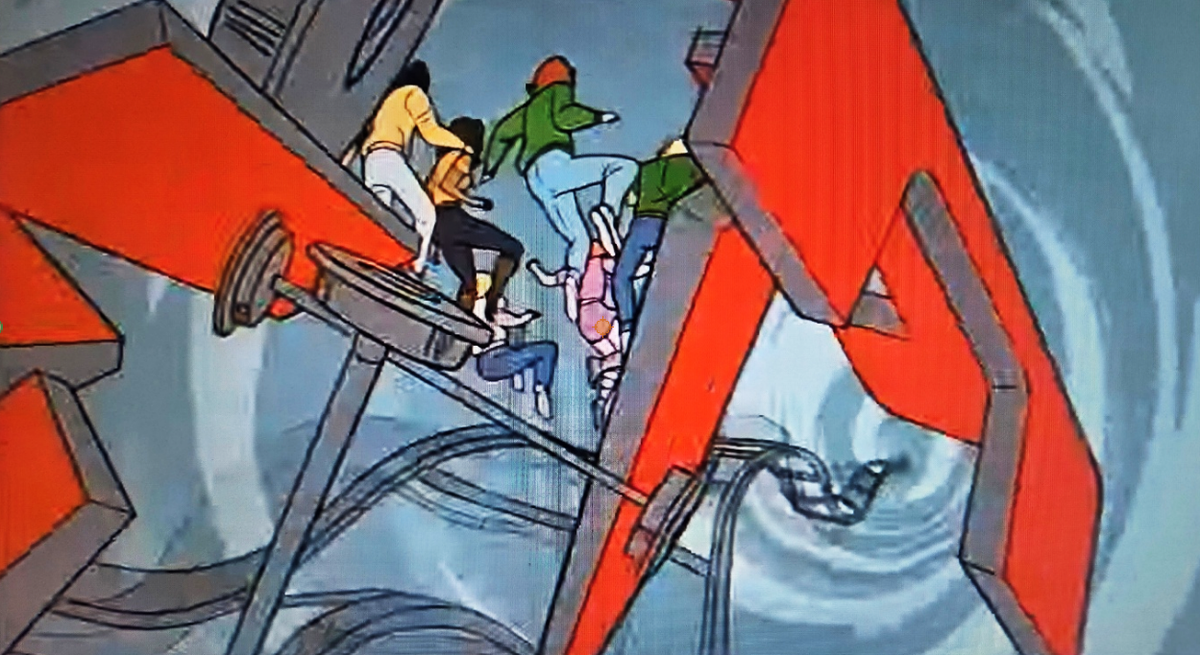
To set the scene, the introduction at the start of the cartoon shows the six friends at a fairground enter the ‘Dungeons and Dragons’ ride; they jump into a cable car outside the ride which takes them into the mountain-like structure through the gaping mouth of a dragon. [^1] At first all seems like a normal fairground ride, until the rail tracks start disintegrating and gravity disappears, floating the friends in the air while a portal sucks them through to another world. When they land in this new realm, they are dressed differently, as if in costume, the colours of which bear similarities to their home world clothes. On arrival to this other place, Tiamat the five-headed dragon appears breathing fire aggressively, as does Dungeon Master, a figure in a red robe, who gifts them with objects of power and titles in order to defeat the dragon. Hank or now ‘Ranger’ is gifted a bow, Bobby or ‘Barbarian’ a club, Presto or ‘Magician’ a hat, Sheila or ‘Thief’ a cloak, Eric or ‘Cavalier’ a shield, and Diana or ‘Acrobat’ a pole. These are not ordinary objects, but magical objects, or objects of power, so that, for example, the cloak grants invisibility, and the magician can pull objects from his hat.
The group are sometimes referred to as ‘young pupils’ by Dungeon Master. He speaks to them in riddles and through their trials they acquire cognitive skills as well as the physical and magical skills needed. And there is much to learn. This is perhaps most apparent with the magician whose hat, it seems, has a wicked sense of humour. When asked to produce hamburgers, it produces a cow, when asked to produce light, Presto exclaims “piece of cake” so the hat produces a cake lit with many candles, and when ask to remove attacking snails from his sight, the hat produces a bucket on his head by way of blocking the view. Magic, it seems, needs very precise instructions and I am reminded of that trope being is common in fantasy TV and film where a wish or a spell backfires by keeping to the spoken instructions but subverting them in some slippery manner.
Dungeon Master is a good teacher. He doesn’t solve the problems for the students but rather guides via hints and riddles. In each episode he appears and disappears as if watching from afar and manifests only when necessary for guidance. In the first episode, when Dungeon Master appears suddenly, the magician asks 'where did you come from’, to which he answers ‘Oh, someplace between there and here’. He gives the next set of instructions and disappears behind a rock. The next time he appears in Episode 2, again from seemingly nowhere, Cavalier asks ‘do you always have to do that?’ and he replies smiling ‘no, not always’. His humour is akin to that of the trickster, rarely answering questions directly, even though he most likely knows the answers. He is there to allow the players to find the answer. His methodology is pedagogic, teaching how to think, rather than what to think. He is criticality embodied and there is something very ‘guru’ about this, very enlightened. His non-answer answers turn to questions that move the adventure narrative forward and leave space for the characters to discover and fail and learn. He is always calm even when there is danger, always smiling in reassurance, and sometimes making jokes in dangerous situations, creating a sense of safety or even a nod to this just being a game. It is as if the Dungeon Master knows the group will be fine and, more than that, he enjoys watching them learning and transforming through each adventure, holding their agency as higher than him displaying his own knowledge. He views the situation, or the problem, and creates the path for the students to follow, trip, fail, learn and hopefully pass.
In Joseph Campbell’s ‘The Hero's Journey’ (1949) he suggests that most stories follow the same set of rules and have the same narrative milestones, in more or less the same order. It starts with our hero in ‘The Ordinary World’, they receive the ‘Call to Adventure’, there usually follows ‘Refusal’ of varied strength where the hero eventually agrees to participate, they meet the ‘Mentor’, receive ‘Magical Gifts’, go through ‘Trials’, fighting ‘Monsters’, in a ‘Major Battle’ and finally ‘Return to Ordinary World’. D&D the cartoon follows these milestones with one exception; there is never a return home, while every adventure is aimed at that conclusion. The friends do not seek to find treasure, win the princess or prince or defeat the evil monster. They just want to return home. Off the cable car and back out through the mouth of the Plexiglas spray-painted fairground dragon’s mouth, crossing the threshold back to suburban America… But their journey remains incomplete to standard narrative structures where a return is almost always guaranteed. The characters are perpetually incomplete in this way, suspended, liminal, but they are also always becoming.
For example, Eric appears to be selfish and cowardly but as the episodes continue, he becomes more courageous. Importantly though, he always remains a bit cowardly; he doesn’t transform wholly into the heroic knight that other narratives might have him become, instead he is continuously becoming, building, gathering. Another example of becoming is Presto whose magic hat rarely operates as he intended it, so instead of becoming a skilled magician, Presto adapts to working experimentally, responding to his materials and finding meaning through uncertainty and failure. The binary equation of hero-making is dismantled here in favour of a slower more considered accumulation of change, of becoming something subtly different but the same.
A becoming is always in the middle; one can only get it by the middle. A becoming is neither one nor two, nor the relation of the two; it is the in-between. . . (Deleuze and Guattari 1987)
With both Eric and Presto as examples we might see how a Deleuzian framework fits very well. The concept of always becoming is present, as well as their concept of encounter as thought producer. Further Deleuze and Guattari preferred assemblages (agencements) to the individual and we might then view a D&D party as an assembled group encountering materials and situations and responding with actions together and in relation to each other. The party becomes one unit, flipping the traditional notion of a singular ‘hero’, with the Dungeon Master as the facilitator of becoming.
What is also important is how we carry ourselves in openness to and through these encounters. How we might be open to understanding other horizons than our own; other landscapes, languages, histories, cultures, objects, species, human, or non-human, experiential learnings. Maria Lugones’ essay ‘Playfulness, "World"-Travelling, and Loving Perception’ (1987) describes the idea of travel as moving from situation to situation (or world to world) and being perceived differently in each place - whether that place is hostile or welcoming - as if we constantly change as we ‘travel’ between worlds. “The shift from being one person to being a different person is what I call 'travel.'” She wrote of the importance of play and love as we move through unfamiliar worlds to encourage a space for dialogue, rather than competition, judgement and destruction.
Ursula K Le Guin’s ‘The Carrier Bag Theory of Fiction’ (1986) tells of what she calls the traditional ‘killing story’ – the hero overcoming a great quest, a battle, an enemy – and asks us to consider instead the quieter stories, the ones where grains are gathered or a baby is fed or a walk is taken, where no one is killed and no grand transformations occur. She asks us to consider what is at stake if the ‘killing story’ continues. She asks us to insert ideas of community, reciprocity, slowness, quiet, gathering, nature, and babbling water and non-hierarchical actions that contrast with Campbell’s well-known heroic structure.
It is hard to tell a really gripping tale of how I wrested a wild-oat seed from its husk, and then another, and then another, and then another, and then another, and then I scratched my gnat bites, and Ool said something funny, and we went to the creek and got a drink and watched newts for a while . . . (Le Guin 1986)
In RPGs, this sense of ‘gathering’ (through campaigns, party, encounter, improvisation, failure, learning) is perhaps stronger than the sense of ‘battle’, where the greater objective is accumulation of experiences and kinship, rather than destination. It is certainly that way in the cartoon, with the characters learning and growing together, never reaching their home, but does this carry over into real RPG campaigns? Do players absorb the character’s adventure as their own? Do they take on their learnings? Are players the carrier bags collecting encounters, stories, memories? Can role-playing function as Le Guin’s carrier bag, transporting experiences from one realm to another, from there to here?
I would go so far as to say that the natural, proper, fitting shape of the novel might be that of a sack, a bag. A book holds words. Words hold things. They bear meanings. A novel is a medicine bundle, holding things in a particular, powerful relation to one another and to us. (Le Guin 1986)
While the Dungeons & Dragons animated series and TTRPG presents as a heroic quest, its incomplete journey, or indeed its paused live campaign, defers closure in lieu of becoming or in lieu of repeating. The monsters, magic and journeys are the surface fiction, but the real story beneath is one of becoming and of gathering. In this way, the cartoon becomes a mirror to role-playing itself; a narrative about crossing the boundary between reality and imagination, inhabiting alternative identities, and returning changed but never entirely separated from the experience. In RPGs, there is a becoming through fictional material encounters, an evolution of character, but also of player through character.
When the character Blaine Faulkner in The X-Files episode ‘Jose Chung’s From Outer Space’ is being interviewed about an alien encounter, Chung asks him “Aren't you nervous telling me all this? After receiving all those death threats?" To which Faulkner replies: “Well, hey, I didn't spend all those years playing Dungeons and Dragons and not learn a little something about courage.” This line redefines ideas of RPGs by dissolving the boundary between fantasy and the physical world, or at the very least, making it permeable. It suggests fiction has the power to shape identity, and that fictional worlds, while remaining fictional, can have an impact on reality. It suggests evidence that fiction has leaked out of its frame, crossing over, being productive in our physical world and ‘fictioning’.[2] It suggests that this can happen over a long period of time (“all those years”) with the accumulation of small acts of courage.
Here fiction produces reality. D&D is no longer just fantasy play, but it proposes D&D as an aid to develop genuine emotional, ethical, and cognitive skills, as well as friendships and community. It sets up the landscape and rules that allow the rehearsal of situations and allows us to react to those situations. TTRPGs are not an escape from reality, but a technology for rehearsing reality. The dragons and dungeons may not be real, but the laughs, the disappointments, the camaraderie, the ways of thinking, the ways of listening, and the courage is real – and the problem solving and negotiations that may seem defined to fantasy problems, piggyback into our physical, dragon-less, world. Here fantasy and our physical world converge. Their interface is miscible and transferable; a porous, permeable, iridescent jelly-like substance, easy to cross through and sticky to wash off. This is not escapism as much as it is a continuous threshold crossing, gathering and carrying interactions from real life to the game and back again in our carrier bags, always incomplete while shimmering with iridescence, and conjuring new realities and new understandings from the small, slow moments found in fictional narratives and role-playing games.
Author
Dr Karen David is an artist and researcher. Through diagrams, writing, making, curation and workshops, her fiction-led research inhabits the intersection between imagination and physical world. Exhibitions include 'New Contemporaries' at the ICA, 'The Restless Surge of the Liquid State' at SE8 Gallery, London, 'The Fortune Telling Fan' at Worcester Art Gallery and Museum, and 'The Collector's Room' at JGM Gallery, London. Writing includes articles for the Journal of Contemporary Painting (JCP) and texts for artists including Juan Bolivar, Andy Holden, Sally O'Reilly and Alaena Turner.
Footnotes
[1] It is worth noting here that it was not unusual in the 80s to have real people dressed as ghosts or zombies or some other creature inside the dark recesses of the rides who would jump out saying boo or grrr or whatever was most appropriate.
[2] A term used by Burrows and O’Sullivan in their 2019 book Fictioning: The Myth-Functions of Contemporary Art and Philosophy that posits fiction as an active, experimental, practice of performing, assembling, mapping and diagramming to bring forth fiction into reality.
Campbell, J. (1949) The Hero with a Thousand Faces. New York: Pantheon Books.
Burrows, D. and O’Sullivan, S. (2019) Fictioning: The Myth-Functions of Contemporary Art and Philosophy. Scotland: Edinburgh University Press
Deleuze, G. and Guattari, F. (1987) A Thousand Plateaus: Capitalism and Schizophrenia. Trans. by B. Massumi. Minneapolis: University of Minnesota Press.
Gygax, G. and Arneson, D. (1974) Dungeons & Dragons. Lake Geneva, WI: TSR, Inc.
Le Guin, U. K. (1989) 'The Carrier Bag Theory of Fiction', in Dancing at the Edge of the World: Thoughts on Words, Women, Places. New York: Grove Press, pp. 165–170.
Lugones, M. (1987) Playfulness, "World"-Travelling, and Loving Perception. Hypatia 2, no. 2: 3-19
Marvel Productions and TSR (1983–1985). Dungeons & Dragons [TV program]. CBS.
Morgan, D. (Writer), & Bowman, R. (Director). (1996, April 12). Jose Chung’s From Outer Space (Season 3, Episode 20) [TV series episode]. In C. Carter (Executive Producer), The X-Files. Fox Broadcasting Company.